Canberra Lawyer Bites the Dust

Continuing a recent spate of disciplinary action aimed at keeping the ACT profession in line, a Canberra Family Law Solicitor has had his name removed from the roll over admitted misuse of client trust funds.

In April 2014, Slater voluntarily disclosed to the ACT Law Society that he had improperly used the trust funds.

An investigation revealed Slater had paid himself about $63,286.50 in advance of any work undertaken for the client, or in excess of work completed.

The matter was referred to the ACT Civil and Administrative Tribunal, which found him guilty of professional misconduct and recommended his name be removed from the roll of legal practitioners.

Slater did not contest the hearings and ACAT also ordered he pay the Law Society’s costs.

The law required the matter then be referred to the Supreme Court, which made the order to remove Slater’s name from the roll, with his consent.

Excerpt courtesy of Michael Inman’s Canberra Times article.

A Brief History of…Slush Funds

The term “Slush Fund” in its modern connotation leaves a dirty taste in most peoples mouths. Common in business and politics, slush funds can have legitimate purposes but are most commonly associated with fallen governments and embarrassed politicians such as Abbott’s secret fund to fight One Nation, the notorious Union political slush funds or even more notorious examples like Nixon’s side hobbies.

The word slush originates as a little bit of onomatopoeia dating back to the mid 17th Century, probably from Swedish “slask” for a damp soggy ground or from the Danish “slus” for sleet. As a side note, on the tree of languages English is damn close to the Germanic and Scandinavian languages (closest relative language being Dutch), hence these are usually the best starting point for any word that does not appear to have Greek or Latin origins.

Slush first appears in English in the 18th century as a reference to the slushy part of animals; the fat. It was almost solely in nautical usage relating to the grease at the bottom of salted meat barrels. The term probably jumped over into English following the naval detente that arose after each of the Anglo-Dutch wars (a somewhat forgotten series of wars during which the English were defeated and sole domain of the Spice Islands was handed to the Dutch.)

It was common practice for the grease at the bottom of these barrels, or the thick layer that rose to the top when boiling, to be saved and sold onshore to candle and soap makers. These sales were treated on a “don’t ask don’t tell” basis by the brass and the proceeds were split between the Officers.

Hence Slush Funds were an off-the-books account used to benefit secret or priority groups, and almost always associated with luxurious purchases. It’s a pretty easy jump to politics. The term first appeared in a political context following the US Civil War. It referred to contingency funds set aside by Congress, outside of the regular budget for special projects and was usually associated with carpet-baggers.

Anecdotally there is usually considered a difference in the legitimacy between Pork-Barrel politics and Slush Funds even though both terms are almost certainly from the same source.

The term “greasing the palm” and its variants are probably also drawn from a reference to slush funds…good to know.

Law Change Clarifies No Right for Private Parking Fines

Operators of private parking facilities need to apply for status as an authorised parking authority or they have no right to issue fines under new legislation that passed the Legislative Assembly on Thursday.

Pre-empting a court determination, the ACT Legislative Assembly moved to clarify the rights of the Road Transport Authority to refuse to hand over driver information to private companies.

Parking in a private space longer than you have paid for is best characterised as a breach of contract or possibly even trespass but the issuing of fines is punitive and therefore represents more than any actual loss suffered by the driver staying longer. Actual losses would more likely be assessed to be in the realm of $8-13, instead of the current ~$80. Parking operators are able to apply for official status as a parking authority under a model which sees the government collect fines whilst the operator gets the revenue from the drivers. Alternatively the operator is free to install boom-gates which means that they are able to directly recover any apparent “losses” from drivers overstaying their paid time.

The current recovery system for the pay-and-display operators is to issue the notices and then request driver registration information from the RTA in order to seek private enforcement of the so-called debt.

The court action was triggered when the Government refused to hand over the registration information essentially blocking the efforts of the parking operators to collect on their “fines”.

Additional changes included in the legislation include the creation of an offence for drinking alcohol whilst driving, banning bicycles on public roads that are powered by “an internal combustion engine”, and clarifying that “drifting” is dangerous driving.


Canberra Times Article.

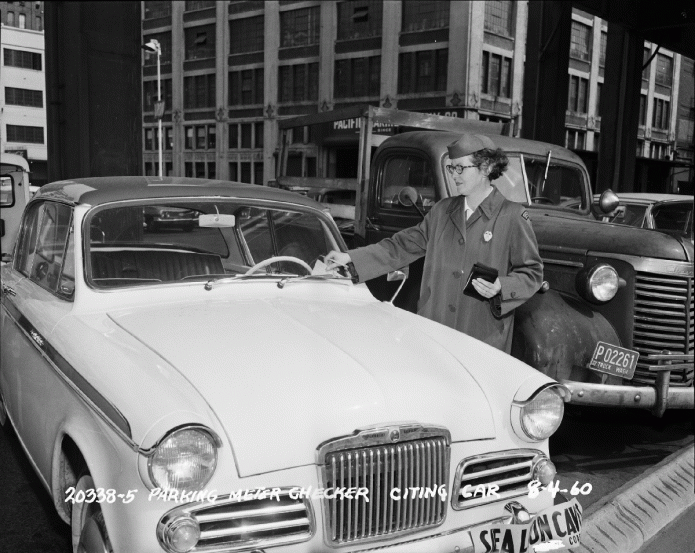
Image courtesy of “Seattle parking checker, 1960” by Seattle Municipal Archives from Seattle, WA – Parking checker, 1960Uploaded by Jmabel. Licensed under CC BY 2.0 via Wikimedia Commons – https://commons.wikimedia.org/wiki/File:Seattle_parking_checker,_1960.gif#/media/File:Seattle_parking_checker,_1960.gif