I’m baaaaack – they didn’t have any milk

Yeah, I’m thinking I’m back.

They’re calling it 9/11, but good.

I won’t bore you with what i’ve been up to in the last 10 years but the general highlights are: learning to rhyme on time, almost competing at the Sochi Winter Games, blockade running Cuba, mastering the correct mix of sugar and yeast in a brioche and so on. Otherwise this blawg was sadly placed into early retirement when I started consulting for the Attorney-General’s Department. I broke the golden rule of commercial practise – work with the govt but never for the govt.

I quite enjoyed the role, I was able to work on some pretty major litigation and I certainly learned a lot about how sausages are made, even if just from the point of view of the farmer but not necessarily the point of view of the pig.

Otherwise you dozy mares, let me take you back to the heady days of 2018, Australia wasn’t in any particular danger at the time, and nor have we really been since basically ever, but nonetheless Slowmo and his malcontents determined that criminal prosecution was appropriate for any government employee or contractor who negatively commented on government policy even if doing so anonymously – fucking crazy right! (It’s a little more nuanced but that’s the crux of it). I maintained a security clearance and would never talk about my govt work – but please don’t cancel me, it was normal commercial Cth stuff, not war crimes or tricking mentally ill people into committing terror crimes, I promise.

Nonetheless, this attack on speech had a major chilling effect on all public servants, including myself, especially when this was interpreted by the courts to include policy which an employee wasn’t even working on. As in, a federal employee working at the National Library as a book returns clerk could face criminal prosecution for posting on Insta that they thought our immigration policy was neither liberal nor neo.

You can imagine how this made me re-think my chosen hobby of discussing and critiquing judicial decisions, regulatory practices and the general decrepitude of the commercial legal industry. I even paused writing my toilet pulp “Fantastic Briefs and where to find them” focusing on the funnest cases Australia has ever seen. It was a dark time and I can only assume that the entire legal industry paused until I was ready to return.

Writing this blawg originally was like having an STI, I was motivated, I was on a roll, I was putting out twice a week, I was itchy, I was showing reckless abandon for spreading it, and then all of a sudden I found myself confined to a convent. Even though I was subsequently released from the convent, the damage had been done. I was chastised, I was rebuked, I was clean. I thought about revisiting the scene multiple times but I had learned the wrong lessons. Continuing with this awful analogy, I was now wearing condoms, learning about coils and dams, i was being more discriminatory about my choice of audience and i was otherwise showing a general reluctance to let anyone know what I had going on. I’ve never been active on any social networks and I’d previously viewed this as my primary and only outlet. That’s saying that I lost something when I lost this outlet and didn’t really have any alternative. This is all a very self-indulgent way of saying that I’ve left the desert and I’m ready to re-enter the land of milfs and honies. Let’s just say that when the Butlerian Jihad inevitably happens I’ll be dying on the frontlines of Team Human.

Once bitten, 8 years shy. Regardless, I’m back. I can’t promise twice weekly like the golden days but I do have about 10 half-written piles of slop in the bank to feed to you piggies and I’ll promise to aim for at least 1 per month going forward. If i don’t hit that, please assume I’ve been abducted and send money to cover my pitifully low ransom – also can someone please water my bonsai. (Further don’t actually ever send money, I’ll never ask for it and if someone does it’s not me)

DEATH TO AI, DEATH TO SPECULATIVE ASSETS, DEATH TO THE MARS COLONY.

Honi soit qui mal y pense

Party Like It’s (Almost) Your Birthday!

There are so many themes to choose from for this post! I could go with The Pirates of Penzance because the prosecutor in the case thought it would be a good idea to quote it(!?). Or I could go with The Sound of Music for the song “16 going on 17” and involving a young lady facing peril? But ultimately I think I have to stick with my heart. It’s a tale of the passage of time and how different people interpret it…therefore, as a Nolan-head, I have to run with Inception.

The Associate Justice recently had to deal with a case where the Magistrate and Prosecution, at first instance, agreed that someone who was 17, on the eve of their 18th birthday, was actually 18.

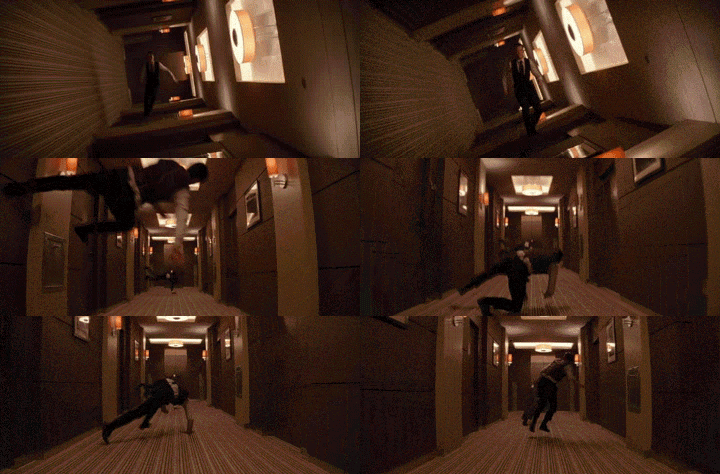
inception cafe

In September 2018, Associate Justice McWilliam handed down a decision on appeal from the ACT Childrens Court (sic).

The Defendant appearing before Chief Magistrate Walker in the Childrens Court (sic) charged with certain criminal offences. The twist on this common tale is that the Defendant was born on 29 February 2000 and that she committed her alleged offences on 28 February 2018, being a common year (non-leap year).

The key question before the Court was therefore whether she had obtained the age of 18 by the time of the offences or not. If she was a child she would remain in the Childrens Court (sic) and if not she would be tried as an adult in the Magistrates Court facing significantly harsher repercussions.

16 going on 17

At first instance, Chief Magistrate Walker determined that the Defendant had obtained the age of 18 and therefore should be tried as an adult. An appeal was brought. Finding that someone is 18 when they haven’t had their 18th birthday may seem like conflated legal conjecture but it does at least have some legs at least.

giphy (1)

Mathematics is a field usually eschewed by lawyers, but usually more from ignorance rather than relevance. Before the Associate Justice, both parties contended that the matter was a simple one of mathematics and that the exercise would be guided by section 149 of the Legislation Act 2001 (ACT):

Section 149 – Age in years
For an Act or statutory instrument, a person is an age in years at the beginning of the person’s birthday for the age.

inception van

Referring to the Magistrate’s decision and quoting the Associate Justice:

17. The magistrate determined that the plaintiff was an adult by applying The Attorney-General v Smith (1985) 39 SASR 311 (Smith), which in turn relied on the earlier authority of Prowse v McIntyre (1961) 111 CLR 264.
The date upon which the offence is alleged to have occurred is the day before the respondent’s eighteenth birthday.  The question is whether the respondent had “attained the age of eighteen years” within the meaning of the definition of “child” in s 4 of the Act on that day.  …
It is clear law that a person attains his majority at the first moment of the day preceding his twenty-first, or under the present law his eighteenth, birthday: Prowse v McIntyre (1961) 111 CLR 264.  The rule is so lacking in rational foundation and is so out of touch with ordinary usage, that I would be most willing, if it were possible, to restrict it to the determination of the date upon which a person attains full legal capacity. I am satisfied, however, that the rule cannot be so restricted.  It is true that the statements of the rule and of the authorities, for the most part, refer to the attainment of the age of majority.  It has been understood, however, as applying to the attainment of any age.  In In re Shurey: Savory v Shurey [1918] 1 Ch 263 it was applied to determine the age at death of a beneficiary under a will who died on the day before his twenty-fifth birthday, the gift in the will being to such of the testator’s three sons “as shall attain the age of twenty-five years”.  Sargant J. formulated the point to be decided in the case as follows: “Does a person attain a specified age in law on the anniversary of his or her birthday, or on the day preceding that anniversary?” That case was cited with apparent approval by Dixon CJ in Prowse v McIntyre (1961) 111 CLR 264 at 271.   In the same case, moreover, Windeyer J, although discussing the rule in the context of the attainment of full age, said: “The rule, is, moreover, not consistent with the law’s method of computing lapse of time for any purpose unrelated to reach an age.” (Italics mine) (1961) 111 CLR 264 at 281. I have reluctantly reached the conclusion that there is no escape from applying the rule to the attainment of any age and for any purpose unless the context in which the expression as to age is used indicates an intention to the contrary.
22.      Sections 11 and 12 of the CYP Act respectively define “child” and “young person” as follows:
Adult means an individual who is at least 18 years old.
Inception ellen.gif
The prosecution also relied upon other definitions in the Legislation Act including the definitions of a “calendar month” (being one month), a “year” (being 12 months) and a “month” being a period beginning at the start of any day of one of the calendar months and ending (a)   immediately before the start of the corresponding day of the next calendar month; or (b)   if there is no such corresponding day—at the end of the next calendar month.
35. The plaintiff relied on simple maths.  Putting to one side 29 February, the anniversary of any other date occurs either 365 or 366 days after the date in question.  To find that the anniversary of 29 February was 28 February would cause the anomaly that the anniversary occurs after only 364 days, which the plaintiff submitted would be an absurd outcome.

The Associate Justice further relied on a friend of the blawg, the Macquarie Dictionary, which defines birthdays as:

1. The day of a person’s birth

2. The time of origin or beginning of a thing

3. The anniversary of someone’s birth or the origin of something.

The prosecution then took flight with the dramatic and ridiculed the defence (appellant) argument as simplistic whilst quoting the deception of the character Frederic from The Pirates of Penzance who was free to leave the pirates once obtaining 21 years old but couldn’t because he only had a birthday every 4 years.

Though counting in the usual way, years twenty-one I’ve been alive,

Yet, reckoning by my natal day, I am a little boy of five!

(W S Gilbert and Arthur Sullivan, The Pirates of Penzance (1879), Act II),

The Associate Justice determined that the legislature, by creating section 149,  clearly intended to cure the mischief whereby someone could be 18 without reaching their 18th birthday.

AsJ’s decision was consistent with  s 37A of the Acts Interpretation Act 1901 (Cth) which provides:

Attainment of particular age
For the purposes of any Act, the time at which a person attains a particular age expressed in years is the commencement of the relevant anniversary of the date of the birth of that person.

Using AsJ’s words: “it follows that on the proper construction of s 149 of the Legislation Act, on 28 February 2018, the plaintiff was not yet an adult, being someone who was ‘at least 18 years old’, because she had not yet reached the beginning of the anniversary of her birth. It was only on 1 March 2018 that she became someone who was ‘at least’ 18 years old.”

This is all likely a concept that Billy Biceps at Moose would instinctively understand when someone presents their ID but one that only lawyers would consider a point worthy of multiple proceedings and lengthy arguments (and costs!). Good luck to everyone that tries to get admitted to a bar on the eve of their birthday based on an application of the common law.

Fun Fact Round-Up

  1. Koreans count someone as one year old from their birth, not their first birthday.
  2. The Northern Territory has broken with the rest of Australia by confirming the common law test instead of clarifying that you only turn the age on your birthday. On ya NT.
  3. There is no Federal act displacing the common law test, meaning that in recent age, Brennan CJ, Gleeson CJ and, Callinan and Heydon JJ each handed down decisions on the eve of their second last day prior to their 70th birthdays, or as the common law would have it, just barely within their jurisdictional competence. 

Don’t Mess With Adelaide’s Homies

Feral pigeons can be public health pests. They can accumulate wherever there is food and shelter, and can take up residence almost anywhere, including around houses, tall city buildings or schools. As well as being a nuisance and causing extensive damage to property, feral pigeons can also pose a risk to human health.

That statement from the South Australian Health Department would seem to suggest that the SA Government considers that pigeons are a pest that requires control, yet in another installment from the state that keeps on giving, pigeons enjoy more legal protection in South Australia than just about anywhere.

The important caveat on that statement is that the specific protections only apply to a specific type of pigeon, being the homing pigeon.

pigeon typing.gif

(Commercial Lore’s editor-in-chief)

Under South Australia law, it is a specific offence to harm a homing pigeon. Moreover, the law prohibits unspecific ‘interference’ with a homing pigeon. It is not sure what ‘interference’ means, but you can probably hazard a guess. If you’re dead-set on messing with homing pigeons, just kill the thing, don’t interfere with it. Be a criminal, not a monster.

Sure, there are easier ways to break the law – pigeons are probably quite difficult to interfere with – and when you factor in the costs of a defending a charge, it is probably worth directing your efforts elsewhere. Just don’t let any prospective employers or potential romantic partners learn of your misdeeds. They’re probably not going to be OK with it. Ask me how I know…go on…ask me!

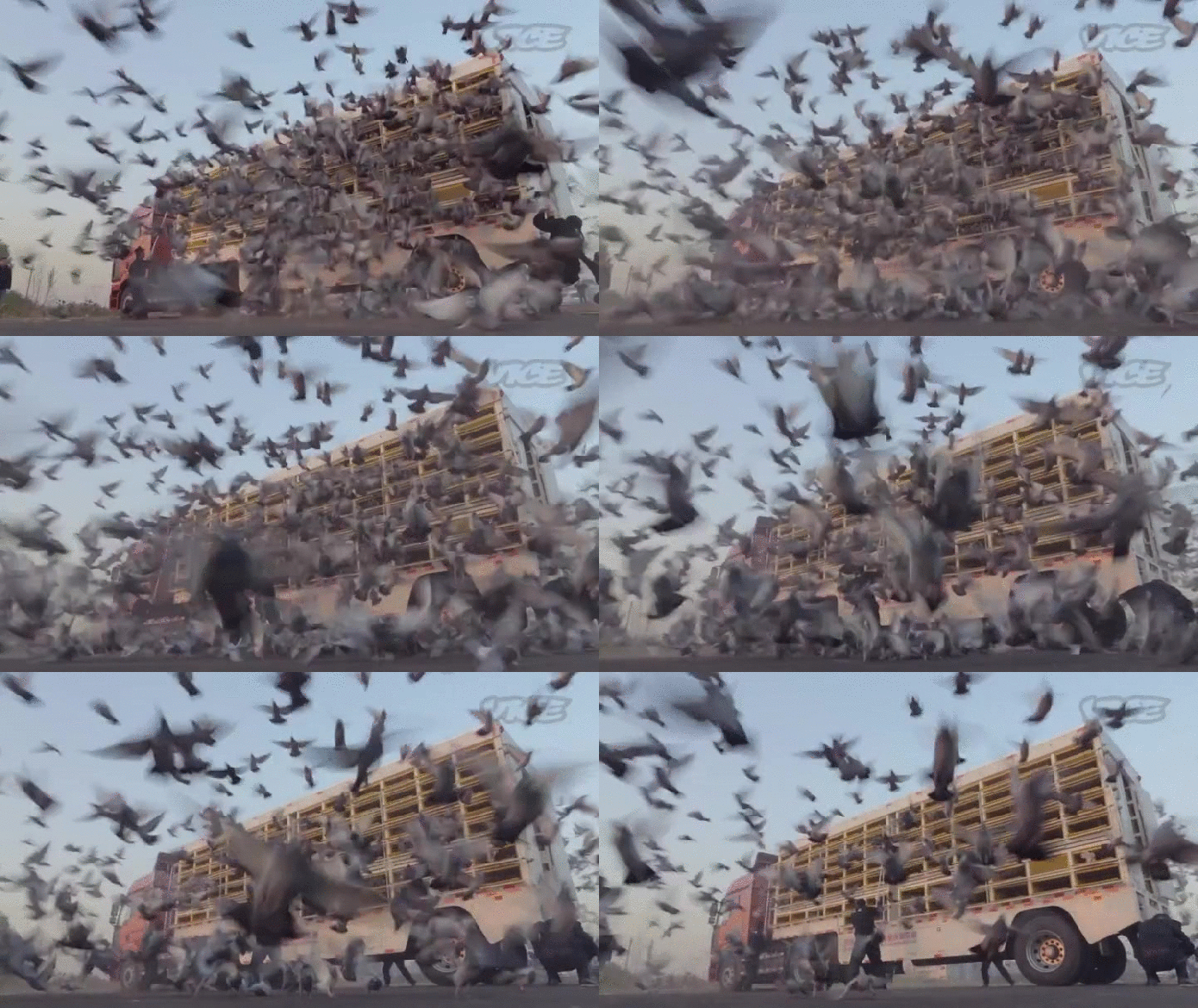
Putin Pigeon.gif

The law doesn’t just single out killing homing pigeons as a specific offence. Homing pigeons are also protected from being assaulted or kidnapped.

47—Interference with homing pigeons 

        (1)         A person who—

(a)         without lawful authority, kills, injures or takes any homing pigeon; or

(b)         enters upon any land for the purpose of killing, injuring or taking any homing pigeon without lawful authority,

is guilty of an offence.

Section 47 of the Summary Offences Act 1953 (SA) singles out the fixating fowls as a sub-category of animals deserving of protection beyond the already broad (and much harsher) provision of section 13 of the Animal Welfare Act 1985 (SA) which allows for up to 2 years imprisonment and a $50,000 fine.

The specific crime of killing, injuring or taking a homing pigeon is punishable by a fine of only $250, which pales in comparison to the 2 years imprisonment facing anyone harming any other animal.

home alone pigeon.gif

The law itself is straight-forward but there are a number of further intrigues that make this law somewhat more unique; specifically:

  1. Instead of defining homing pigeons as any pigeon which has been trained to operate as a homing pigeon, the SA law instead defines a homing pigeon as any pigeon with a ring around its legs.

    Now I’ll be the first to admit that I’m not familiar with the practices of raising homing pigeons, but it has to be more specific and more readily identifiable than simply being any pigeon with a ring around its leg.

    There doesn’t even need to be a message capsule – if you like to make your pet pigeon jewellery, get it a leg-ring first. That way, if it gets into any trouble, the police can step in and fine the offender $250.

  2. Upon finding a person guilty of an offence, the Court can instead order the person to pay the replacement value of the harmed pigeon.

    A quick search of gumtree shows that this is likely $6-60, further questioning the need for a specific provision in this regard.

  3. It is a complete defence to harming a homing pigeon if you are a farmer or if you are under the direction of a farmer.

    There is no particular guidance for how far this exception stretches. The test is “cultivated land”. But it is not clear whether growing tomatoes in your backyard allows you to claim this defence. Either fortunately or unfortunately, this exception does not appear to have been tested.

As with many of these bizarre provisions under the Summary Offences Act (Exhibit A, Exhibit B), it is proving impossible to trace the underlying reason behind these exceptions or to find any actual cases where this provision has been tested; which only further confounds the reasoning behind the actual reason for the law.

To stay on the right side of this law next time you are in Adelaide, I would advise that it is perhaps best to restrain from harming any pigeons just in case your target turns out to be a highly trained homing pigeon…unless you’re a farmer, in which case, its game on.