Court Rejects Late Inclusion of Statutory Defence

The Supreme Court considered, and duly rejected, a late application for pleading a statutory bar against the Nominal Defendant from seeking contribution in Jausnik v Nominal Defendant [2015] ACTSC 251.

The primary case was a high profile claim for compensation by an ACT Police Officer from the Nominal Defendant claiming psychological damage, who subsequently sought contribution from an individual police officer and NSW. The Plaintiff and the individual officer arrived on the scene of a motor vehicle accident following a NSW Police pursuit.

The first third party, being the individual officer, has sought to plead a bar under the NSW Police Act protecting individual members against personal liable:

Section 213 of the Police Act 1990 (NSW) (‘Police Act’) provides:

213  Protection from personal liability

A member of the NSW Police Force is not liable for any injury or damage caused by any act or omission of the member in the exercise by the member in good faith of a function conferred or imposed by or under this or any other Act or law (whether written or unwritten).

This bar wasn’t pleaded until late in the game (after pleadings closed and even settlement) so the Court naturally turned to the Court Procedures Rules and our old friend Aon Risk. Particular points that were drawn from Aon include;

  • First, generally speaking where a discretion is sought to be exercised in favour of one party and to the disadvantage of another, an explanation will be called for so as to permit the circumstances giving rise to the amendments to be weighed in the discretionary balance: [103]
  • Parties have a right to bring proceedings but have to make choices as to what claims are made and how they will be framed and prosecuted.  Limits will be placed on the ability to change the case they wish to run.  That is why in seeking the just resolution of the dispute, reference is made to the parties having sufficient opportunity to identify the issues they seek to agitate: [112].
  • The reference in the Rules to the need to minimise costs implies that an order for costs may not always provide sufficient compensation and therefore a just resolution to an application for leave to amend.  It cannot therefore be said that a just resolution requires that a party be permitted to raise any arguable case at any point in the proceedings upon the payment of costs.

Ultimately Associate Justice Mossop was reasonably scathing of the application to amend and include the statutory defence. Mossop AsJ noted that the application was “extremely late”, making the application was “wholly attributable to lack of thoroughness in the [first third party’s] camp” (read professional liability claim), the amendment would create a complete defence and the amendment would essentially require reopening the question of liability including lengthy adjournments [38].

Aon Risk is essential reading for anyone hoping to conduct commercial litigation or wishing to challenge the Fourth Horseman to a game of chess. Like playing Death in Chess, commercial litigation requires punters to not commence anything without being thoroughly aware and prepared, and to have planned at least 3 moves ahead at all times if not able to win in 6.
3 things about Winding-Up Courtesy of Chen -v- College of Building

Notice of a genuine dispute is enough to set aside a Winding-Up Application despite the company apparently failing to meet the strict time requirements of the Statutory Demand.

In Chen v The College of Building Ltd [2015] ACTSC 248, Justice Penfold heard an appeal against the order of the Registrar setting aside a statutory demand despite evidence the statutory demand wasn’t complied with.

Mr Chen sent a statutory demand in December 2014 and the 21 day period for compliance or set aside expired, apparently before it was even received by the College in January 2015. In any event, the College replied on the day it claimed to receive the demand disputing the existence or validity of the debt, restating positions that evidence revealed were already disclosed to Mr Chen.

The chronology and general interactions between the parties are covered ad nauseam at [12] and [13].

3 things to take away from this decision:

  1. Late Provision of Evidence Isn’t Enough to Defeat a Set Aside Order (necessarily)
    The College had earlier raised challenges to the existence of the debt and prior to the appeal presented supplementary evidence relating primarily to the provision of mail collection over the Christmas break. This additional evidence arguably could have been presented to Mr Chen earlier but the Registrar had already dismissed the winding up application on the evidence available. Penfold J determined that this additional evidence was merely supplementary and not directly relevant to whether the application should be dismissed. In this vein the advice is, generally speaking, get as much of your evidence on as soon as possible, especially when the winding up of a company is at stake. But the fact that you haven’t put on every little scintilla of evidence won’t defeat your position provided the relevant evidence is already available (common sense right?).
  2. Don’t Appeal a Winding-Up Dismissal Without Good Reason
    Appealing the dismissal of a winding-up application requires the strategic nous of Von Clausewitz, which the Court doubted Mr Chen held [32]. In this instance the application was dismissed partially on the basis of there being a genuine dispute, something which the applicant admitted at appeal [30]. If a genuine dispute has been established then this is sufficient to have a statutory demand set aside. By the time the College filed it’s supplementary evidence it was already too late for Mr Chen to have the College wound up on the basis of failing to comply with the statutory demand as the Statutory Demand had reached its 3 month limit and couldn’t have been enforced in any event as it was now “stale”. The Court was understandably sceptical of the pursuit of the appeal and concluded that Chen probably only pursued it to improve his costs position…though how this would have accomplished this end was not clear. [23]
  3. Tactics Can’t Override the Existence of a Genuine Dispute
    The Court examined the apparent strategic positioning of Chen’s litigation:

(a)       the statutory demand was served in full knowledge that it was unjustified, and that Mr Chen would struggle to make out his claim in substantive litigation; and

(b)       it was served in the hope that:

(i)        the exigencies of the Christmas/New Year period would prevent the College responding to it appropriately;

(ii)       such a failure by the College would enable Mr Chen to threaten to seek the winding up of the College in insolvency; and

(iii)      such a threat would enable Mr Chen to negotiate a settlement of his dispute with the College without having to pursue the disputed debt, and establish it, in the courts in the usual way. [31]

The Court PROBABLY gave undue credit to the strategy of Mr Chen but the overall message was pretty clearly spelled out to the parties; strict reliance on the technical aspects of the law won’t generally defeat an otherwise readily defensible position

These extracts are merely reminders of a few things apparent in most areas of the law; in addition to the directly above semi-coloned point, the Court will (almost) always look more favourably on the party that appears more reasonable.

The aspects surrounding the Christmas shutdown do seem generous considering the apparent failure. The Court must have really held doubts regarding the service of the demand as the Corporations Act is intended to set a strict timeline sometimes with harsh outcomes and it is the responsibility of companies to ensure that they have adequate mail collection provisions in place and respond accordingly to statutory demands.

Sidebar: Despite the Legislature gazzumping the measurement of time from the Universe and International Meridian Conference and vesting it between the Legislation Act and the Court Procedures Rulesthere seems to be a blackhole that surrounds the ACT practice concerning the Christmas “shutdown” and how the Court should consider notices presented over this time in spite of the (pretty easily understandable) rules in place. Perhaps its due to the extraordinary Public Service ACT practice of indulging in an excessive “shutdown”. Plus yes, I do mean blackhole in the most literal sense, in that time does seem to bend and become largely subjective and fungible the closer we get to the event horizon of the “shutdown”.

Bankrupts: Top 3 ACT Suburbs

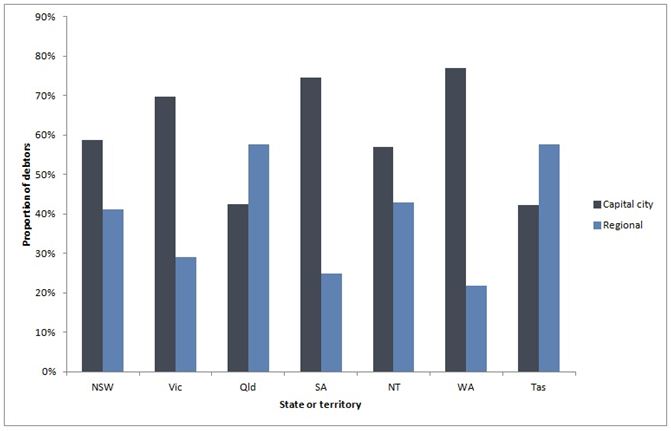
The Australian Financial Security Authority (AFSA) have released national bankruptcy data for only the third time and the results are mildly interesting.

Adjusted per capita, the naughtiest debtors in Australia live in Newcastle West (NSW) with 1 in 75 people being declared bankrupt, Ilfracombe in outback Qld in second with 1 in 80 people and then Bumberrah and Johnsonville (VIC) bringing up third with 1 in 94 people.

For the ACT, there was one debtor per 733 adults in ACT in 2013–14, compared with 546 adults in Australia. This is below the national average and actually represents a slight dip for the ACT when adjusted for an increase in population over the last 4 years.

The most violent trend is the number of Territorians entering into (Part IX) Debt Agreements which has been increasing rapidly with almost double as many debtors compared to 2010 levels (190 vs 100).

ACT

Top 3 postcodes with the highest proportion of debtors:

2914 – Gungahlin – 28 bankrupts equalling 1 in 332 people

2606 – Woden – 17 bankrupts equalling 1 in 391 people

2913 – Gungahlin – 45 bankrupts equalling 1 in 412 people

Top 3 postcodes in relation to highest number of bankrupts:

2615 – Belconnen – 54 bankrupts equalling 1 in 608 people

2913 – Gungahlin – 45 bankrupts equalling 1 in 412 people

2905 – Tuggeranong – 39 bankrupts equalling 1 in 550 people

ACT Bankruptcy Report 2013-2014