Most people will never encounter sumptuary laws, but they do still exist in some less obvious forms. Sumptuary laws are those designed to prevent and regulate certain types of excessive consumption. Sumptuary laws are most closely associated with clothing and have been concurrently used to oppress people and promote social cohesion such as preventing people wearing clothes designated above their station and preventing undue flaunting of wealth.
Mediaeval England
Mediaeval England is well known for its sumptuary restrictions on what colours one could wear, what fabrics they could dress in, the length of one’s sword and even the decorations that could be on your horse. Most of the laws were largely unenforced as nouveau riche merchants grated against the old establishment who had the most to gain from preventing the flaunting of wealth by those less worthy.
The Tudor’s were the most notorious for this and appropriately The Tudors tv show has provided us with this insightful chart:

The English tradition of sumptuary laws also extended to the playing of sports such as Tennis, Port only being available to Officers and not the other Naval riff-raff and the flaunting of certain food such as eating mince pies on Christmas Day, although this was probably because of its Pagan origins.
Elsewhere
The British Isles were by no means unique in these rules. Most European countries had similar laws and 16th century Italy went super specific and even regulated who could wear a jewelled Sable head on the hilt of their sword.
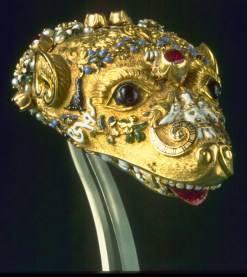
In China peasants could wear goat, sheep or rat skins whilst the higher ranks were permitted more exotic furs such as Sable or Weasel. When Russian traders introduced the sea otter to China, it lead to the near extinction of the poor buggers. The Otter was a new creature and similar in quality to some of the more exotic furs. As it was novel, the Otter was not covered by any of the existing classifications making it extremely popular and lucrative. In a strictly hierarchical society, the opening to bend the rules without breaking them was greeted with great enthusiasm. The “Sea Dragons” were uniquely profitable for the traders and Otter numbers have still not recovered.
A similar fate was in store for North American Otters and Beavers whose pelts were favoured by the British.
Many American states had sumptuary laws in the 20th century but this was usually intended at social morals such as preventing the wearing of KKK outfits or men wearing drag.
Etymological Origins
The word sumptuary comes from our old Roman friends and is another one of those words that provides a root to a number of current words. Sumere is the earliest Roman form of the word as we know it, but even this was a contraction of sub-emere. Mere could conversely mean “to buy”, “to take” or “to spend” and sub means “under”, sumere was a broad term to to borrow, buy, spend, eat, drink, consume, employ, take, take up etc.
The past participle of sumere is sumptus resulting in sumptuarius meaning something that related to expenses. The word then did one of those weird historical retrogressions where the Latin sumptuosus jumped into Old French as sumptueux and around the 17th Century joined English in the form of Sumptuous, resembling its Latin origin more than it’s French iteration.
Sumere is found in a number of other English words, most frequently in the suffix “-sume”. “Consume” to take something up, “resume” to take again, “presume” to take before entitled etc.
Australia
Australia has never really had any true sumptuary laws apart from the odd hangover from the British, but even these were quickly dispensed of in the luxury starved colony.
The early Australian protectionist taxation regime often had the same effect as sumptuary taxes such as high import tariffs on fabrics. This essentially meant that imported silks and velvets etc. were exclusively for those who could afford it whilst the average Aussie was restricted to woollen clothing.
Perhaps the only meaningful current sumptuary law in Australia is the luxury car tax adding 33% to any imported luxury car. Perhaps with the euthanasia of the Australian car industry, this tax will be abolished shortly, but with the constant budget emergencies…probably not.
Want someone who knows what they’re talking about, read this chap: Alan Hunt, Governance of the Consuming Passions: A History of Sumptuary Law (MacMillan Press Ltd, 1996)