Registry Remedies “Defective Processes”

A few months ago I wrote about Adhesive Pro P/L -v- Blackrock Supplies P/L, in which an application to set aside a Statutory Demand failed largely because the Court turnaround for stamping the documents did not return the application for serving until after the strict 21-day period for service.

The  Court was pretty scathing of the “defective administrative processes” in the Registry as well as the delay by the solicitors, then acting, for the Applicant.

Read the original post here.

The ACT Magistrates Court has reacted by releasing a new Notice to Practitioners which outlines the new procedures for filing and stamping of documents.

The notice states that the Court will stamp, rather than seal, documents for service on other parties. The stamp will include the date the document was originally filed.

This does not address the issue of Registry turnaround time but does provide parties with a stronger tool to prove that a served document is a true copy and was indeed filed at the stated time.

Rule 6304 of the Court Procedures Rules allows the Court to stamp a document instead of sealing it to indicate that it is a true copy of a filed document.

A Brief History of…Sumptuary Laws

Most people will never encounter sumptuary laws, but they do still exist in some less obvious forms. Sumptuary laws are those designed to prevent and regulate certain types of excessive consumption. Sumptuary laws are most closely associated with clothing and have been concurrently used to oppress people and promote social cohesion such as preventing people wearing clothes designated above their station and preventing undue flaunting of wealth.

Mediaeval England

Mediaeval England is well known for its sumptuary restrictions on what colours one could wear, what fabrics they could dress in, the length of one’s sword and even the decorations that could be on your horse. Most of the laws were largely unenforced as nouveau riche merchants grated against the old establishment who had the most to gain from preventing the flaunting of wealth by those less worthy.

The Tudor’s were the most notorious for this and appropriately The Tudors tv show has provided us with this insightful chart:

chart-of-sumptuary-laws

The English tradition of sumptuary laws also extended to the playing of sports such as Tennis, Port only being available to Officers and not the other Naval riff-raff and the flaunting of certain food such as eating mince pies on Christmas Day, although this was probably because of its Pagan origins.

Elsewhere

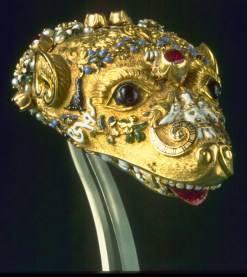
The British Isles were by no means unique in these rules. Most European countries had similar laws and 16th century Italy went super specific and even regulated who could wear a jewelled Sable head on the hilt of their sword.

Italian Marten's Head

In China peasants could wear goat, sheep or rat skins whilst the higher ranks were permitted more exotic furs such as Sable or Weasel. When Russian traders introduced the sea otter to China, it lead to the near extinction of the poor buggers. The Otter was a new creature and similar in quality to some of the more exotic furs. As it was novel, the Otter was not covered by any of the existing classifications making it extremely popular and lucrative. In a strictly hierarchical society, the opening to bend the rules without breaking them was greeted with great enthusiasm. The “Sea Dragons” were uniquely profitable for the traders and Otter numbers have still not recovered.

A similar fate was in store for North American Otters and Beavers whose pelts were favoured by the British.

Many American states had sumptuary laws in the 20th century but this was usually intended at social morals such as preventing the wearing of KKK outfits or men wearing drag.

Etymological Origins

The word sumptuary comes from our old Roman friends and is another one of those words that provides a root to a number of current words. Sumere is the earliest Roman form of the word as we know it, but even this was a contraction of sub-emere. Mere could conversely mean “to buy”, “to take” or “to spend” and sub means “under”, sumere was a broad term to to borrow, buy, spend, eat, drink, consume, employ, take, take up etc.

The past participle of sumere is sumptus resulting in sumptuarius meaning something that related to expenses. The word then did one of those weird historical retrogressions where the Latin sumptuosus jumped into Old French as sumptueux and around the 17th Century joined English in the form of Sumptuous, resembling its Latin origin more than it’s French iteration.

Sumere is found in a number of other English words, most frequently in the suffix “-sume”. “Consume” to take something up, “resume” to take again, “presume” to take before entitled etc.

Australia

Australia has never really had any true sumptuary laws apart from the odd hangover from the British, but even these were quickly dispensed of in the luxury starved colony.

The early Australian protectionist taxation regime often had the same effect as sumptuary taxes such as high import tariffs on fabrics. This essentially meant that imported silks and velvets etc. were exclusively for those who could afford it whilst the average Aussie was restricted to woollen clothing.

Perhaps the only meaningful current sumptuary law in Australia is the luxury car tax adding 33% to any imported luxury car. Perhaps with the euthanasia of the Australian car industry, this tax will be abolished shortly, but with the constant budget emergencies…probably not.

Want someone who knows what they’re talking about, read this chap: Alan Hunt, Governance of the Consuming Passions: A History of Sumptuary Law (MacMillan Press Ltd, 1996) 

Canberra Rugby Riots Save the World

With the Rugby World Cup Final about to emotionally drain me for another weekend I thought it was worth briefly looking at a great chapter when three of my favourite things combined: Rugby, Canberra and Civil Disobedience.

Let me take you back to the good ol’ days when Rugby was amateur, people cared enough to take to the streets and South Africa was oppressed under the jackboot of the apartheid state.

ACT v South Africa

In 1971 the South African Rugby Team toured Australia and everywhere they went they were met with anti-apartheid protests. On 21 July 1971 they played at Manuka Oval in Canberra.

The picturesque white-picket fence of Manuka Oval was complemented with two lines of police officers and a 2 metre fence was erected around the boundary for the first time with sandbags placed over any loose fittings to prevent protestors using them as weapons. Additionally and rare for the time as, patrons were searched for bottles and cans for the first major usage of the Public Order (Protection of Persons and Property) Act.

The Menzies government had recently brought in the Public Order (Protection of Persons and Property) Act in May 13, 1971 to fill the gap in the law that prevented police from taking action against otherwise lawful protests.

Kindly, the “apparent policy of A.C.T. police has been to provide close escort, or a major show of force, for large demonstrations” but that actively combatting civil unrest “often tends to make the crowd remain compact, and likely to react violently to any attempts to break it up.”

The Police came down on the protesters in large numbers, but did not attempt to prevent or disperse the actual protest. Presumably a state based aggressive response to a peaceful protest against another state’s based aggression seemed a little too ironic. 400 Police came from NSW to assist their ACT colleagues.

The Canberra Times quoted a protester who complemented the ACT Police that day “I’ve seen police a lot rougher than they were here. In NSW they kick first, then ask them to move on.”

Over 1,000 protestors piled into Manuka Oval with whistles, making the entire match entirely insufferable for the players who were subjected to the non-stop blow of whistles making the referee’s calls almost impossible to hear.

Unfortunately the video was too large to post but here is a great 5 min clip of the game providing a perfect idea of how noisy the protesters were. 62 charges were laid that day and the issue became a point of contention in Parliament.

Over the course of the tour a number of players excluded themselves from the home teams in protest over the policies of the South African Government.

The game finished in a 34-3 drubbing of the ACT but the South African captain Hannes Marais stated that it was a hard and enjoyable game. South Africa stayed undefeated during the tour.

Wider Implications

The UN declared 1971 the International Year of Action to Combat Racism.

A SA cricket tour was scheduled for the 1971-72 summer tour but was cancelled and replaced with a World XI when the Chairman of the Australian Cricket Board, some guy called Donald Bradman, declared that there would be no more tours allowed from South Africa until the team was selected on a non-racial basis.

Australia was forced to examine its own attitudes towards it’s indigenous population in light of our ardent criticism of the South African regime and the hypocrisy that came with that stance.

The Whitlam Government later introduced a Government ban on sporting tours from South Africa, which was kept in place by subsequent governments and credited largely for the 1977 Gleneagles Agreement at the Commonwealth Heads of Government Meeting general ban on sporting relations between the Commonwealth and South Africa. The Commonwealth ban was echoed by the Soviet Union, but importantly not the United States.

The Commonwealth ban particularly hurt South Africa as their two major sports, Rugby and Cricket, were played almost exclusively in Commonwealth nations.

Despite the ban, New Zealand allowed the Springboks to tour in 1981 despite widespread public protest and International condemnation. NZ considered SA to be their greatest rival and did not want to pass up the opportunity to test their mettle. NZ subsequently came into line with the international position and no further tours occurred until the collapse of apartheid in 1994.

The Australian role in leading the charge against international sporting engagement with SA is considered to be one of the better weapons used against the SA government to highlight to it and its people just how out of touch their racist policies were with the rest of the world. The stance by the various boards and Whitlam government can be attributed in no small part to the popular protests that disrupted the Springbok tour and highlighted the morally shaky position of criticising a regime as racist but continuing to engage with it.

My basic premise is that: Protests around Australia followed the SA tour around, Canberra students et al.  protest in ’71, in ’72 Cricket Australia bans SA and Whitlam bans any racially selected teams and then in ’77 the Gleneagles Agreement is signed…ergo, small events in Canberra can change the world if the momentum is right and the passions are running strongly enough.