
ACAT’s Missing Powers; Episode 6 – Return of the Enforcement Officer

In Episode 4 we dealt with the ACAT’s new civil jurisdictional limit whilst Episode 5 covered the inability to deal with a vindictive/tactical counterclaim. The ACAT’s legislative hamstringing does not stop there however and in episode 6 we face the difficulty of enforcing an order of ACAT once you are able to obtain one in your favour.

The enforcement process is notoriously difficult and cumbersome in any event. I often have conversations with clients that go something like “But I have a court order in my favour, why can’t we just get paid now?”, “It’s not that simple”. Some forms of orders are much simpler than others. A money order from the Supreme Court is much easier to enforce than say an order to vacate premises made by ACAT.

In a recent case, the ACAT determined that a man was not entitled to continue living in his deceased ex-wife’s house and duly made an order for his eviction. The Trustee for his wife’s estate attempted to execute the orders and could not directly enforce orders of the ACAT. So he registered the order in the Magistrates Court in an attempt to have the order enforced through those court processes. This is the normal course of enforcing ACAT orders as the Magistrates Court holds coercive powers that ACAT does not. The Magistrates Court could for example order an employer to re-direct wages or to seize bank accounts. Unfortunately, they and the ACAT, don’t have the power to make orders relating to the possession of real property (a house), and the Trustee was required to have his application transferred to the Supreme Court.

Finally, after a delay of many months, the Trustee was able to obtain a valid order to enforce the ACAT judgment. This was probably small consolation for someone who thought their legal struggle was finalised a long time before.

The judgment sums it up nicely:

13. Section 22 of the ACAT Act gives the ACAT, in relation to civil dispute applications, “the same jurisdiction and powers as the Magistrates Court has under the Magistrates Court Act 1930, Pt 4.2 (Civil jurisdiction).”  That jurisdiction is described in s 257 of that Act as jurisdiction to hear and decide “any personal action at law”, though, of course, with a monetary limit – $10 000 in the ACAT: s 18 of the ACAT Act; $250 000 in the Magistrates Court: s 257 of the Magistrates Court Act

34. Unfortunately, however, the Magistrates Court has, as noted above (at [29]), no jurisdiction to make an order for the recovery of possession of land.  See r 2440 of the Court Procedures Rules 2006 (ACT). Any such enforcement must to be undertaken in the Supreme Court.

37. It is not clear whether the Registrar was relying on the dispensing powers under r 6 of the Court Procedures Rules or relying on the provisions of r 6461 which permit informal service to be accepted as service for the purpose of Pt 6.8.

38. Because there was some doubt as to whether the order of the ACAT was directly enforceable by this Court, the Supreme Court Registrar also directed Mr Kaney to issue an Originating Application seeking an order for delivery of possession of the Property. No doubt the order of the ACAT would have been strong evidence in support of such an application.

To show the gaps in the implementation of the ACAT, I had to recently bring it to the attention of the  Justice Directorate that the Supreme Court didn’t even have a specific filing fee for the filing of orders for enforcement. We would have had to pay the full fee for commencing new proceedings (~$3000); a situation now rectified.

As a creature of statute, the ACAT was always going to have trouble with dealing with certain jurisdictions and enforcing certain orders. For example, practitioners will regularly blush at attempting to convince a Magistrate that they may hold the inherent powers of the Supreme Court when the Magistrates Court legislation is found to be lacking. But given that the ACAT enabling legislation was specifically crafted to give ACAT exclusive jurisdiction over residential tenancy disputes, one would think that it would be prudent to give them the power to actually make enforceable eviction orders.

 

South Australia has a Ban on Being Too Frigid

Apologies already for the misleading title, but “South Australia Has Limits on the Size of Your Fridge” is nowhere near as sexy.

The law itself is easy enough to explain but the purpose behind it is somewhat more intriguing and required a lot more research than you would expect…so you’re welcome.

Disclaimer: All puns are the pundits own and Commercial Lore takes no responsibility for the puns, both terrible and amazing, contained herein.

The Law

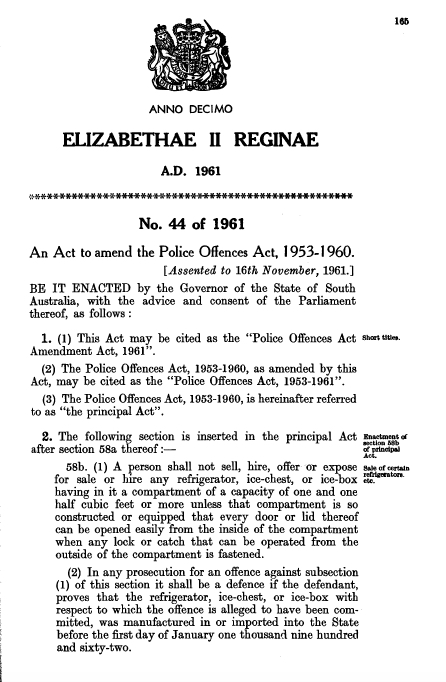
The South Australian law was enacted in 1961 in response to an apparent spate of deaths following people becoming trapped in fridges that could only open from the outside.

Under s58b of the Summary Offences Act 1953 (SA), it is illegal to sell or hire a fridge over 42.5 litres that cannot be opened easily from the inside. Or as the law originally stated any fridge over “one and one half cubic feet”…simpler times. Make South Australia Great Again.

A grandfather clause was also introduced providing an exception for any fridge that was purchased or imported to South Australia prior to 1962. The penalty for a person found with a husky esky is $750 of cold hard cash.

In addition to being illegal to sell or hire one, it is also illegal to dispose of one either through dumping (already illegal) or even placing one on a “dump, tip or sanitary depot”.

pg1-fridge-copy

pg2-fridge-copy

It’s proven impossible to find any convictions under this section but one could presume that at some stage a policeman broke out a measuring tape and asked whether their refrigerator was running.

Large Fridges Used to be Cool

This does not just appear to be a silly law, but rather an interesting time-capsule. It makes sense that fridges should be able to open from the inside to prevent unfortunate events. But compared to other states, it is interesting to consider whether South Australia’s fridge death problem was so great that they had to uniquely regulate the types of fridges people could sell. This law is probably past its use-by-date but it’s not hurting anyone, so you know, who cares.

“The first thing we do, let’s kill all the lawyers”

Zelino and Ors v Budai [2001] NSWSC 501 (24 July 2001) is a case of some notoriety involving fraud, deception, backsta…

Stop reading. Put the popcorn in the microwave. I’ll wait.

Is your popcorn ready? Good. I’m just going to republish verbatim the opening two paragraphs of the judgment:

1) In 1725 Mr Everet commenced proceedings in the Court of Exchequer against Mr Williams seeking an account of partnership profits. The plaintiff alleged that the partnership between himself and the defendant dealt in commodities such as plate, rings, watches and other valuables, that the plaintiff and the defendant had dealt successfully in these commodities in the course of the partnership but that the defendant had failed to come to a fair account with the plaintiff concerning the partnership profits. In the course of the trial it was revealed that the business in which the partners were engaged was actually highway robbery and that the plaintiff was aggrieved that the defendant had not handed over a fair share of the spoils. The case was thrown out of Court, both parties were hanged, the plaintiff’s solicitors were attached for contempt and the plaintiff’s counsel was made to pay the costs of the proceedings: see Everet v. Williams (1893) 9 LQR 197; cited in Burrows v. Rhodes [1899] 1 QB 816, at 826 per Grantham J.

2) Human nature does not change. These proceedings are another example of that obstinate folly which blinds people to the ruin to which their course of action must inevitably lead if they insist upon pursuing it. For at the heart of these proceedings lies a series of revenue frauds perpetrated by the plaintiffs which would never have seen the light of day had the plaintiffs not set their minds on coming to a court of law to vindicate their grievances.

HOLY MOLY. Strong words. When you’re sitting in court and the judgment opens with a story about both parties being hanged and the solicitors found in contempt you know you’re in trouble.

Human nature does not change

The heart of this case is about dodgy individuals and the professionals who assist them. It is a story that should remind every legal practitioner, and in fact all professionals, that your client’s problems are not yours. If you assist in their criminal scheme, at worst you are part of their criminal enterprise and at best you are undertaking your own unique crime.

In Zelino, a group of investors purchased a heritage property in Cremorne and hired Mr Budai, a registered tax agent to structure the group’s tax affairs. The tax scheme was fraudulent, at the knowledge of all parties, and the lodged returns significantly understated the group’s taxable income.

The ATO provided their assessments and determined that the group still owed some tax. It “rankled” the group that they had to pay any tax so they spoke to their solicitor. Their solicitor, aware of the fraudulent scheme, approached a tax specialist and provided him information about the fraud. After a lengthy and expensive period of consideration, the tax specialist provided representations to the ATO that Mr Budai had a poor knowledge of the law and was incorrect in the original assessment. The ATO accepted the submissions based on further fraudulent and misleading statements and declared that no tax was payable.

The group was still not happy and commenced proceedings to sue Mr Budai for the costs of the specialist.

if im going down

In the ensuing Supreme Court action, all of the roles of the co-conspirators were revealed including that of the solicitor who was also appearing. Everyone involved was, frankly, stuffed:

238) It would be an affront to justice and to all professional people striving to maintain the ethical standards of their calling if the Court, having become aware of possible serious breaches of the law by members of a profession, turned a blind eye and failed to draw those matters to the attention of the relevant authorities and professional regulatory bodies for further investigation.


244) According, I make a further direction as follows: I direct that the Registrar of the Court forward a copy of this judgment to the Australian Taxation Office, the Tax Agents Board, the Law Society of New South Wales, the Australian Institute of Chartered Accountants and the Public Accountants Registration Board.

The Judge even ordered that a letter be sent with the judgment to the Law Society concerning a member of the group who was formerly a solicitor to provide evidence of his character should he attempt to apply for admission in the future.

People Can Change

Nope. These lessons seem to stay only relevant for a certain amount of time and usually only to a limited audience.

In the ever-unfolding saga that is the ATO PAYG scandal, at least two lawyers have been revealed to be intimately involved in the scheme and will now be charged along with their former clients. The profession doesn’t want or need lawyers willing to engage in this chicanery, but there’s usually someone waiting to take their place.

The line in the title of this piece is from Shakespeare’s ‘Henry VI,” and is often misquoted to posit that maybe society would be better if we killed all the lawyers. Shakespeare intended the opposite reading. The line is uttered by Dick the Butcher who believes the rebel he supports could climb the chaos ladder if they were to cause a bit of mayhem and the people who would first get in his way are the lawyers and judges charged with administering justice. I’m definitely probably biased, but I don’t think we should “kill all the lawyers”, just remind them that schemes to defraud the public purse and other such arrangements cannot succeed if lawyers and other professionals are keeping their professional duties at the forefront of their minds.