A Brief History of…Sumptuary Laws

Most people will never encounter sumptuary laws, but they do still exist in some less obvious forms. Sumptuary laws are those designed to prevent and regulate certain types of excessive consumption. Sumptuary laws are most closely associated with clothing and have been concurrently used to oppress people and promote social cohesion such as preventing people wearing clothes designated above their station and preventing undue flaunting of wealth.

Mediaeval England

Mediaeval England is well known for its sumptuary restrictions on what colours one could wear, what fabrics they could dress in, the length of one’s sword and even the decorations that could be on your horse. Most of the laws were largely unenforced as nouveau riche merchants grated against the old establishment who had the most to gain from preventing the flaunting of wealth by those less worthy.

The Tudor’s were the most notorious for this and appropriately The Tudors tv show has provided us with this insightful chart:

chart-of-sumptuary-laws

The English tradition of sumptuary laws also extended to the playing of sports such as Tennis, Port only being available to Officers and not the other Naval riff-raff and the flaunting of certain food such as eating mince pies on Christmas Day, although this was probably because of its Pagan origins.

Elsewhere

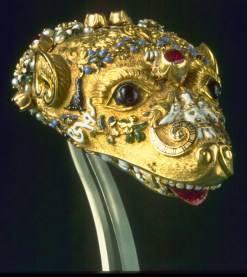
The British Isles were by no means unique in these rules. Most European countries had similar laws and 16th century Italy went super specific and even regulated who could wear a jewelled Sable head on the hilt of their sword.

Italian Marten's Head

In China peasants could wear goat, sheep or rat skins whilst the higher ranks were permitted more exotic furs such as Sable or Weasel. When Russian traders introduced the sea otter to China, it lead to the near extinction of the poor buggers. The Otter was a new creature and similar in quality to some of the more exotic furs. As it was novel, the Otter was not covered by any of the existing classifications making it extremely popular and lucrative. In a strictly hierarchical society, the opening to bend the rules without breaking them was greeted with great enthusiasm. The “Sea Dragons” were uniquely profitable for the traders and Otter numbers have still not recovered.

A similar fate was in store for North American Otters and Beavers whose pelts were favoured by the British.

Many American states had sumptuary laws in the 20th century but this was usually intended at social morals such as preventing the wearing of KKK outfits or men wearing drag.

Etymological Origins

The word sumptuary comes from our old Roman friends and is another one of those words that provides a root to a number of current words. Sumere is the earliest Roman form of the word as we know it, but even this was a contraction of sub-emere. Mere could conversely mean “to buy”, “to take” or “to spend” and sub means “under”, sumere was a broad term to to borrow, buy, spend, eat, drink, consume, employ, take, take up etc.

The past participle of sumere is sumptus resulting in sumptuarius meaning something that related to expenses. The word then did one of those weird historical retrogressions where the Latin sumptuosus jumped into Old French as sumptueux and around the 17th Century joined English in the form of Sumptuous, resembling its Latin origin more than it’s French iteration.

Sumere is found in a number of other English words, most frequently in the suffix “-sume”. “Consume” to take something up, “resume” to take again, “presume” to take before entitled etc.

Australia

Australia has never really had any true sumptuary laws apart from the odd hangover from the British, but even these were quickly dispensed of in the luxury starved colony.

The early Australian protectionist taxation regime often had the same effect as sumptuary taxes such as high import tariffs on fabrics. This essentially meant that imported silks and velvets etc. were exclusively for those who could afford it whilst the average Aussie was restricted to woollen clothing.

Perhaps the only meaningful current sumptuary law in Australia is the luxury car tax adding 33% to any imported luxury car. Perhaps with the euthanasia of the Australian car industry, this tax will be abolished shortly, but with the constant budget emergencies…probably not.

Want someone who knows what they’re talking about, read this chap: Alan Hunt, Governance of the Consuming Passions: A History of Sumptuary Law (MacMillan Press Ltd, 1996) 

Canberra Rugby Riots Save the World

With the Rugby World Cup Final about to emotionally drain me for another weekend I thought it was worth briefly looking at a great chapter when three of my favourite things combined: Rugby, Canberra and Civil Disobedience.

Let me take you back to the good ol’ days when Rugby was amateur, people cared enough to take to the streets and South Africa was oppressed under the jackboot of the apartheid state.

ACT v South Africa

In 1971 the South African Rugby Team toured Australia and everywhere they went they were met with anti-apartheid protests. On 21 July 1971 they played at Manuka Oval in Canberra.

The picturesque white-picket fence of Manuka Oval was complemented with two lines of police officers and a 2 metre fence was erected around the boundary for the first time with sandbags placed over any loose fittings to prevent protestors using them as weapons. Additionally and rare for the time as, patrons were searched for bottles and cans for the first major usage of the Public Order (Protection of Persons and Property) Act.

The Menzies government had recently brought in the Public Order (Protection of Persons and Property) Act in May 13, 1971 to fill the gap in the law that prevented police from taking action against otherwise lawful protests.

Kindly, the “apparent policy of A.C.T. police has been to provide close escort, or a major show of force, for large demonstrations” but that actively combatting civil unrest “often tends to make the crowd remain compact, and likely to react violently to any attempts to break it up.”

The Police came down on the protesters in large numbers, but did not attempt to prevent or disperse the actual protest. Presumably a state based aggressive response to a peaceful protest against another state’s based aggression seemed a little too ironic. 400 Police came from NSW to assist their ACT colleagues.

The Canberra Times quoted a protester who complemented the ACT Police that day “I’ve seen police a lot rougher than they were here. In NSW they kick first, then ask them to move on.”

Over 1,000 protestors piled into Manuka Oval with whistles, making the entire match entirely insufferable for the players who were subjected to the non-stop blow of whistles making the referee’s calls almost impossible to hear.

Unfortunately the video was too large to post but here is a great 5 min clip of the game providing a perfect idea of how noisy the protesters were. 62 charges were laid that day and the issue became a point of contention in Parliament.

Over the course of the tour a number of players excluded themselves from the home teams in protest over the policies of the South African Government.

The game finished in a 34-3 drubbing of the ACT but the South African captain Hannes Marais stated that it was a hard and enjoyable game. South Africa stayed undefeated during the tour.

Wider Implications

The UN declared 1971 the International Year of Action to Combat Racism.

A SA cricket tour was scheduled for the 1971-72 summer tour but was cancelled and replaced with a World XI when the Chairman of the Australian Cricket Board, some guy called Donald Bradman, declared that there would be no more tours allowed from South Africa until the team was selected on a non-racial basis.

Australia was forced to examine its own attitudes towards it’s indigenous population in light of our ardent criticism of the South African regime and the hypocrisy that came with that stance.

The Whitlam Government later introduced a Government ban on sporting tours from South Africa, which was kept in place by subsequent governments and credited largely for the 1977 Gleneagles Agreement at the Commonwealth Heads of Government Meeting general ban on sporting relations between the Commonwealth and South Africa. The Commonwealth ban was echoed by the Soviet Union, but importantly not the United States.

The Commonwealth ban particularly hurt South Africa as their two major sports, Rugby and Cricket, were played almost exclusively in Commonwealth nations.

Despite the ban, New Zealand allowed the Springboks to tour in 1981 despite widespread public protest and International condemnation. NZ considered SA to be their greatest rival and did not want to pass up the opportunity to test their mettle. NZ subsequently came into line with the international position and no further tours occurred until the collapse of apartheid in 1994.

The Australian role in leading the charge against international sporting engagement with SA is considered to be one of the better weapons used against the SA government to highlight to it and its people just how out of touch their racist policies were with the rest of the world. The stance by the various boards and Whitlam government can be attributed in no small part to the popular protests that disrupted the Springbok tour and highlighted the morally shaky position of criticising a regime as racist but continuing to engage with it.

My basic premise is that: Protests around Australia followed the SA tour around, Canberra students et al.  protest in ’71, in ’72 Cricket Australia bans SA and Whitlam bans any racially selected teams and then in ’77 the Gleneagles Agreement is signed…ergo, small events in Canberra can change the world if the momentum is right and the passions are running strongly enough.

Duelling Drongos

In today’s civilised practice the biggest risk to your person is generally a cranky debtor or lower back problems from not standing up enough during the day. There is certainly very little chance that a snarky email or public reprimand will result in pistols at dawn.

I’m not overly interested in tracing duelling back hundreds of years to the concept of trial by combat or discuss outdated concepts of honour. Instead if you’ll indulge, there are a few short tales I think are worth telling including some early judges and lawyers instigating duels over the most seemingly trivial matters. There probably is also some sort of contemporary comparison to club bashings, ie. a violent reaction to someones honour being stained, but I digress.

Duels were not legal in the colonies and were seen by most as a senseless risk of life and at worst as a deliberate act of contempt by taking “justice” into one’s own hands. The Australian colonies and indeed Great Britain were early movers towards classifying duels as “murder” instead of “crimes of honour”, and you only need to consider that ‘merkin President Andrew Jackson (of $20 bill fame) as well as several other signatories of the declaration of independence were ardent participants of several notorious duels.

Depending on how cynical you are of the legal justice system, not much has changed between the colonies and today. Although duels were illegal and ironically punishable by death, it was very rare for a member of the gentry to actually be prosecuted. There was a level of romanticism invoked when gentlemen resolved their differences compared to the common pleb, such as the Adelaide Milkman sentenced to death for killing a nobleman in a duel in 1884 for not paying his milk bill. Despite the Law, the British had their fair go including in 1809 when Lord Castlereigh, the secretary for state, war and the colonies, shot the foreign secretary in a duel just before a cabinet meeting…brilliant.

There were however strict codes of conduct usually enforced by the “Second”, a back-up duellist/referee. In 1840, William Ryrie fired his shot into the air when his opponent Peter Snodgrass shot himself in the foot accidentally.  Snodgrass was a failed pastoralist, long-time Victorian politician and fought land grants to avoid creating an Australian aristocracy. Snodgrass was perhaps lucky in his opponents given that the next year he was involved in another duel with Sir Redmond Barry when he again prematurely discharged his pistol. Barry fired in the air displaying all the honour expected of a Queen’s Counsel, KCMG, facial-hair enthusiast, later Judge of the Supreme Court of Victoria and the inaugural Chancellor of Melbourne University.

There are plenty more early notable duels including the WA barrister and newsman William Clark who killed his opponent in a duel in 1832 and then successfully defended his subsequent manslaughter charge. In 1846 Alexander Sprot and William Campbell travelled 400km+ to get into South Australia after a Melbourne Magistrate specifically told them they would both be arrested for attempted murder if the duel happened in Victoria. (I’ve always liked this one, it seems like a classic rogue lawyer: obeying the letter of the law, not the spirit.) In 1892, lawyer and politician Charles Kingston, was offended when a conservative member of the legislative council called him a “coward, a bully and a disgrace to the legal profession”. Kingston bought two French duelling pistols and sent one to his opponent with a note naming a place and time for the duel. Kingston was “flummoxed” when the Police showed up instead of his opponent holding the note, the pistol and a fresh warrant. Kingston was still serving his good behaviour order when he became the Premier of South Australia in 1893. History books have forgiven Kingston’s many temperamental moments and best remember him for leading the SA government to become the first jurisdiction in the world to extend the voting franchise to women.

If you’ve been following the years and have OCD you’re going to hate this, but I’m jumping around in time now to end with my two particular favourites.

Possibly the most famous duel and duellist in Australian history, is John Macarthur. A real prickly guy, but if Australia had such a thing as the founding fathers, he’d probably be one of them. Macarthur was a legendary grazier, politician, architect, entrepreneur etc. He imported spirits against the orders of the Governor who wanted a dry colony, stacked juries and official positions with mates, deposed 5 Governors during his time and fathered the Rum Corp; which was considered the most corrupt collection of men in Australian history prior to Obeid’s Terrigal group. A fiery Scotsman with an inferiority complex, the first thing Macarthur did when he boarded a ship for Australia was duel Captain Gilbert for a better cabin. Both survived but the Captain was replaced for not responding like a gentleman (ie. don’t duel your passengers) and the Macarthur family transferred to the Scarborough. Macarthur then tried to duel the Scarborough Captain who refused and instead boarded up Macarthur’s cabin’s access to the deck, making him walk through the diseased crowd in the bows of the “hellship” to make it up top. The ship was called a “hellship” due to it’s 30% fatality rate, which included Macarthur’s wife and children. This no doubt contributed to Macarthur’s hatred of the aristocracy and their rules.

Macarthur, using his position as commandant, paymaster and master of public works in Parramatta, used the unpaid salaries of soldiers to fund his import business and arranged for tariffs on other importers as well as using the Parramatta regiment to host his own Boston Tea Parties on rival ships. His aggressive trade policy soon led to him becoming the richest man in NSW. So on and so on, you could write all day about Macarthur and he probably deserves his own poorly-shot Underbelly, but let’s get back to duelling.

In 1801, Governor King, who loathed Macarthur, passed over Macarthur’s man for the equivalent of Attorney-General and fired several of his appointed Magistrates in an attempt to weed out corruption. Macarthur promptly challenged the replacement AG, Colonol Paterson, to a duel. Apparently the entire duel could have been avoided if both Macarthur and Paterson weren’t both intemperate wild Scotsman who refused to backdown. Macarthur jam-packed his own pistol with lead shot (a big no-no), blew Paterson away (he survived) and then show-boated by crowing over his writhing body (another big no-no), apparently saying “King Kong ain’t got shit on me.” That quote might be conflating Denzel with Macarthur, but you get the idea. Macarthur was sent back to England by Gov King to face Court-Martial, knowing that if he tried him in Australia, Macarthur’s loyal officers would simply acquit him. King sent back 3 copies of the duelling charges with a note that apparently read:

               “if Captain Macarthur returns here in any official character, it should be that of Governor, as one-half the                                           colony already belongs to him, and it will not be long before he gets the other half.”

Mysteriously, the copy left with Macarthur didn’t make it to England, the Captain’s copy disappeared from his lock box in transit and the third copy went to the bottom of the Pacific Ocean with the separate ship it was on. Macarthur was sent back to Australia without facing trial and in exchange for handing in his military commission was awarded the largest land grant in Australian history and a flock of Joseph Banks’ stolen Spanish half-breed Marinos to establish the Australian wool industry, which soon paid dividends courtesy of Napoleon’s blockade of Britain. Like it or not, and with the hindsight of history, Macarthur was romantically Australian. America has their Civil War, Britain beheaded a King and then changed their minds and Australia has the Rum Rebellion; backed by Macarthur as a bloodless coup which ousted the Governor via a drunken, singing mob whose only opposition was the Governor’s wife, armed with a paper parasol.

The “Last duel in Australia” happened in 1851 when Major Sir Thomas Mitchell faced off against Sir Stuart Donaldson in Sydney. Mitchell was the Surveyor-General of NSW at the time and was facing heavy criticism from Donaldson about the debt and deficit disaster being created by the department’s expenditure. Both missed 3 separate volleys before the Seconds intervened with honour having been satisfied. One bullet fortunately passed through Donaldson’s hat, allowing Donaldson to go on to become the first Premier of NSW, lasting only two months. When questioned as to why he stood down without a fight, Donaldson gallantly exclaimed “my colleagues and myself are all too independent of office to cling to it“. Obviously the same duty to the office has survived to this day.