Do Australian Courts Speak Australian?

The year is 1981, Peter Weir’s Gallipoli is released, the 4 millionth Holden rolls off the production line and a funnel-web spider vaccine is used for the first time. Oh and also Shaddup Your Face spends 8 weeks at number 1 on the Aussie charts. Australia is coming into its own and the cultural cringe we held for so long is starting to fade.

Since its founding, Australians were grappling with a sense of identity. The historian John Hirst, who passed away earlier this year, in his book Sense & Nonsense in Australian History described the interbellum Australians as “More British than the British”. This issue with identity continued through the 50’s and 60’s summed up by the fact that even Menzies considered himself “British to his bootstraps”. 

The publication of the Macquarie Dictionary in 1981 saw the first time that Australian English was recognised as a seperate dialect worthy of being recorded as distinct from American and British English.

Cutting the Umbilical Cord

Until the Australia Act 1986 (Cth) effectively severed the remaining points of appeal to the UK Privy Council, we were bound to British precedent and ultimately to their norms and to their language. British courts naturally favoured the Oxford English Dictionary, the same way our American cousins favoured Websters and each considered these indigenous dictionaries as the authorities on their dialects.

Susan Butcher, the editor of Macquarie, was kind enough to provide some background on the role of the Macquarie Dictionary in our society and specifically in our courts. “Australian courts, like the rest of the Australian community, were slow to understand that Australian English was an independent variety of English which had developed from transplanted British English but which was now different in many ways.  For a long time we maintained the fiction that we spoke and wrote British English.  It was not until Macquarie Dictionary was published in 1981 that people could grasp the nature of the new variety that had developed here.” 

We were forced to, as a society, make a deliberate transition not only recognise Australian English, but actually embrace it. In Hai v The Minister for Immigration and Multicultural Affairs (2000) 201 CLR 293Justice Kirby chose to interpret the Convention relating to the Status of Refugees (1951) by examining the definitions contained in the Macquarie Dictionary treating it as the starting point of interpretation in Australian Courts. Kirby J noted that the meaning of the terms at the time of the convention must be interpreted along with the general evolution of language, including the Australian evolution (62).

Does Bathe mean Swim?

Kuzmanovski v New South Wales Lotteries Corporation [2010] FCA 876 saw the Federal Court examining the question of whether Mr Kuzmanovski had won $100,000 when his lottery ticket matched the word “Bathe” with a picture of a man swimming. The question to be answered boiled down to was whether doing a few freestyle laps counted as bathing, as understood in Australia.
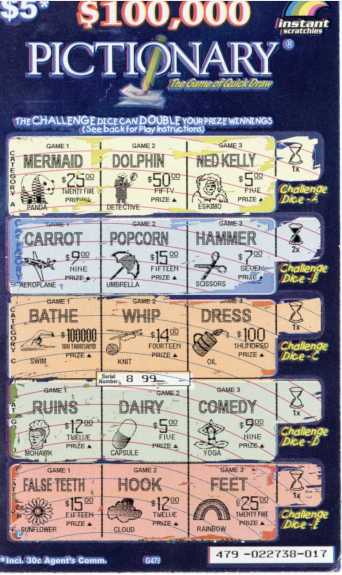
876.1

The Court examined the definition in several dictionaries including the Macquarie Dictionary which provided as a second option for “Bathe” as “Chiefly British: To swim for pleasure”. Some dictionaries agreed others disagreed. Justice Rares ultimately determined that he was not bound to any definition and could rely on his understanding of an ordinary and natural meaning. Rares J did cite in obiter the precedence that the Macquarie should be authoritative noting “in House of Peace Pty Ltd v Bankstown City Council [2000] NSWCA 44; (2000) 48 NSWLR 498 at 506 [33 par 3] Mason P had described it as the “most authoritative Australian dictionary” following what Kirby P had said in Provincial Insurance Australia Pty Ltd v Consolidated Wood Products Pty Ltd (1991) 25 NSWLR 541 at 553.”

Mr Kuzmanovski was successful in showing that “bathe” in an ordinary and natural meaning of Australian English could mean swim and more so he was awarded indemnity costs based on an early offer to settle.

What’s the Difference?

As a collection of Australian English, the Macquarie Dictionary’s mission is to simply record our dialect. This is in stark contrast to the origins and missions of Websters and Oxford. Noah Webster deliberately set out to differentiate American English by making style and spelling choices and imposing them (including trying to change “soup” to “soop” and “believe” to “beleev”). Meanwhile the Oxford’s mission was to publish the most correct definition regardless of common usage.

Apart from uniquely local terms, one quirk to note from the Macquarie Dictionary is its preference for the suffix “ise” instead of “ize”. This reflects a uniquely periodic understanding of the English language originating from how the language existed at the time of settlement and continued common usage. Most people conflate “ize” as being uniquely American, but the Oxford dictionary prefers “ize”, noting the Greek origins make this more correct, despite “ise” being the preferred form amongst the British public.

The Macquarie Dictionary does not actively seek to advocate its role as the guardian of Australian English but does do some helpful prodding along the way. In the 1990’s the Macquarie Dictionary approached the Directors of Education and successfully lobbied for their spellings to be considered the standard for education, or more recently sending more contemporary dictionaries to Federal Parliament when they learnt they were operating on out-of-date Concise Macquarie editions.

Susan Butler: “But it is not for us to push these things, just as it is not for us to decide what words the Australian language community will choose to use and what they will mean by them. If the law courts and the education system adopt the Macquarie Dictionary as a standard, then it is a sign that the concept of Australian English as an independent variety of English has been generally accepted. We are observers, not actors in this sphere.”


 

6 Legal Terms With Bloodthirsty Origins

Words are strange. Their meanings morph and warp overtime, like “Sleazy” referring to inferior Sicilian cloth, or sometimes stay the same but have weird origins, like “OMG” originating from a 75 year old WW1 British Admiral:

“I hear that a new order of Knighthood is on the tapia – OMG – Shower it on the Admiralty”

– John Arbuthnot Fisher, 1st Baron Fisher of Kilverstone

So it is not surprising that such an ancien profession as the law would have it’s fair share of obscure origin stories. So without much ado, here are 6 words or terms commonly used in law with bloodthirsty origins:

1. Deadline

839

Falling into popular usage during the 1920’s amongst American reporters, the term has since come to mean the expiration of any time limit.

BUT…the term originated in 1864 from the American Civil War to refer to a perimeter within prisoner of war camps, which if crossed the prisoner would be murdered. Usually about 19 feet from the outside wall, the Deadline was designed to prevent prisoners from attempting to tunnel or climb the outer wall. Deadlines were used by both sides such as at Union Prison Camp Douglas Chicago. But the use of a deadline was perhaps most notoriously used by Swiss-born Confederate Captain Henry Wirz who commanded Confederate Prison Camp Andersonville. Camp Andersonville (pictured above) was an open air prison that housed over 45,000 prisoners during the war making it the 5th largest city in the Confederacy and had a death rate that reached 3,000 per month, with healthy doses of cannibalism and the general human depravity that usually are the result of extreme hunger. Captain Wirz was tried and hung for his role in the atrocities.

2. Loophole

2e986ecf696c5eee8601398495d4fdbc

A loophole is a figurative means of escape which came into the common usage as early as 1660s. Now it is associated with more technical or legal routes of circumventing an otherwise impregnable system.

BUT…it’s a term from the 1300s coming from the Middle Dutch “lupen” (to watch) and then Middle English “loupe” meaning hole in the wall. Fun fact: a Loupe is the tiny magnifying glass used by watchmakers. A loophole was a slit in Castle walls to allow archers to reign terror down on attacking foes. The loopholes would be narrow on the outside but wide on the inside allowing the archers to hit the attackers from multiple angles without exposing themselves unnecessarily and therefore inflicting the maximum amount of bloody wrath.

3. Mortgage

Grim Reaper

Everyone understands that a mortgage is most commonly a loan, usually from a financial institution and usually secured against an interest in land. The good part is, as most millennials understand it, the definition has not actually changed that much.

BUT…mortgage comes from Old French and is an amalgamation of two Latin/French words. Mort meaning death and Gage meaning pledge. Hence a mortgage was any promise between parties that that was to be a debt until one of them died. The word was first used in English in the late 12th century as a common law term referring to a mechanism to give some sort of protection to a creditor. This appears to be the juncture when the term came to mean something further than just a debt for life, to a term that that became synonymous with the security provided, usually an interest in land until the debt was paid off.

4. Addict

slavery

I don’t think I need to explain what everyone’s idea of an addict is. Instead I’ll use these precious words to whinge about any one who uses the term “Chocoholic” because they clearly do not understand where the “…holic” part comes from. Unless your sister is actually addicted to Cafè Patron, I don’t want to hear it.

BUT…similar to mortgage above, “addict” is from the Latin ad dicere and was the legal term to refer to any debt between people, whether it be money, goods or slaves. If you could not pay the debt, you became an “addict” or were “addicted” (addictus) to the creditor. The creditor could chain up the debtor, force them to work or display them in public as a bad debtor. If no one came forward to pay the debt within 60 days they were formally a slave, entering into indentured servitude. So the term meant to be “bound” or “dedicated” to something or someone. Judges were even said to be addicere judicem, or addicted to justice.

5. Justice is Blind

lady justice

Speaking of Justice, and how blind it is: this is not strictly a legal term, but I’m not stopping until I get to six and it is getting late. This is most commonly understood as justice is supposed to be blind to bias and free from influence to hand down impartial true justice.

BUT…that is the exact opposite meaning of its origin. Lady Justice was based on Themis, the Greek Titaness of law. Justice isn’t supposed to be blind. Justice is supposed to be all seeing. The term started as a joke in a 15th century English satirical cartoon as a commentary on justice being blind and unable to properly apply the law. The cartoon had a jester tying a ribbon around the eyes of lady justice, therefore tricking it. People liked the imagery so much that it kind of just stuck and we changed the meaning later so it was noble again. Lady Justice most often appears blind in her American personifications, whilst the Brits prefer to keep it really old school.

6. Rule of Thumb

Illustration re corporal punishment of s

A rule of thumb is more or less a casual rule where you essentially take a gander at something and make a well educated guess.

BUT…the rule of thumb was the maximum thickness of the instrument through which you could beat your wife. Because it would be unreasonable to beat your wife with a chair for over-frying the eggs, the 17th century Judge Sir Francis Buller supposedly stated that it was fine to beat your wife provided the instrument followed the rule of thumb, probably so as to not damage her re-sale value.


Review: Insolvent Investments

Insolvent Investments, Stewart J Maiden eds., LexisNexis Butterworth, 2015, Chatswood, Australia

This is not a read for the lighthearted. But, Insolvent Investments is a fantastic specialist textbook examining the system of managed investments schemes and their related vehicles. Insolvent investments are a complex and increasingly frequent part of litigation having particularly emerged over the last 15 years. These schemes and the sheer complexity of them takes up an inordinate amount of court time and judicial contemplation.

Managed investment schemes are governed primarily by 5C of the Corporations Act but the judiciary has often been called in to fill the gaps. Specifically, the courts have had to create jurisprudence on how to wind up managed investment schemes and define the duty of officers operating pursuant to such schemes, ultimately defining their obligations as arising primarily under the act and not in a strict fiduciary role.

Insolvent Investments covers everything from directors duties to the rights of third parties and the role of creditors verses the pecking order for allocation of assets following dissolution.

Insolvency and bankruptcy are key areas of legal practise that tangentially permeate so many different areas of law that every practitioner should at least have a fundamental understanding of to allow them offer their clients a full view of their obligations and options.

At the end of the day, if this is not your specialist area of practise, then you will need to consult a specialist. However, to consult that expert on a somewhat level pegging, this book certainly does take you a long way to getting there and will empower you to engage that practitioner from a level of informed knowledge, with all the power of an in-depth exploration drawing from the finest legal, academic and judicial minds dedicated to exploring this specific area of law.

This review has been written for the ACT Law Society who provided the writer with the book.
Tom Barrington-Smith is currently completing his Australian Restructuring, Insolvency &  Turnaround Association advanced certification to supplement his legal qualifications towards certification as a specialist insolvency practitioner.