The best laid schemes o’ Mice an’ Men, Gang aft agley, An’ lea’e us nought but grief an’ pain, For promis’d joy! Still, thou art blest, compar’d wi’ me!
Setting legal precedents on fictional characters could work in theory. I would love to examine a world where decisions about who owned a rug was adjudicated by asking “what would Geoff ‘the dude’ Lebowski do?” or “Would Stringer Bell, as a reasonable person, have made that property transaction?”. It would certainly make things more interesting.
Get to the point
So the United States is a country. And Texas is a state in that country. And sometimes they’re known, though not the most known (am I right Oklahoma?!), to pass crazy legal precedents.
Anyway, in Texas they still have the death penalty. Just like Sudan and Iraq? Yeah, I know it’s weird. So in 2002 the US Supreme Court decided 6-3 that the 8th amendment ban on “cruel and unusual punishments” precluded states from executing people who were considered mentally retarded. (and before anyone says anything, that is a completely acceptable medical term, retarded just means less developed or prevented, blame society if the word has taken on a new meaning).
In Atkins v Virginia the US Supreme Court determined that a person’s disabilities in areas of reasoning, judgment, and control of their impulses means that their level of moral culpability is diminished and therefore must fall short of the normal death penalty pre-requirements to find the most serious adult criminal conduct present. The major problem was that the Supreme Court left open the definition of mentally retarded…you must see where this is going.
So shortly after that decision, the “crazy” states started re-writing their laws to comply with new requirement that you could, in some circumstances, execute a mentally retarded person. Texas took a novel approach (pun definitely intended). A lower court Texas Judge decided to refer to material that the common man could relate to. Much like the ancien common law requirements of the “common passenger on the Clapham omnibus” or “Bondi Bus” in Australia, Texas decided to resort to a book that every year 10 in the western world has read.

A lower court Texan Judge took this approach and in 2004 had the reasoning affirmed by the Texan Court of Criminal Appeals. The basics of the decision is that Texas has adopted what is known at the “Lennie test“; if a person is more retarded than Lennie then they are safe to execute but if they have more cognisance than Lennie then they are not safe to execute.
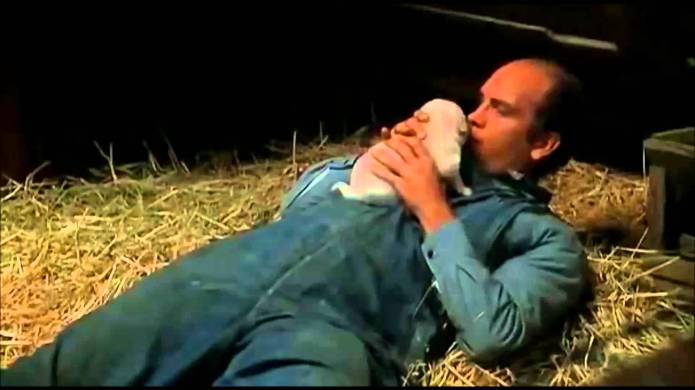
In Steinbeck’s classic “Of Mice and Men”, Lennie was a kind-hearted oaf whose strength was a weakness when juxtaposed against his child-like innocuous understanding of the world. [SPOIL-IES ALERTS-IES]. Lennie’s strength comes back to bite and first he pets a puppy to death and then steps up his game and strangles the rancher’s son’s wife to death when he’s confused by her sexual advances. I must add, beautifully played by the masterful John Malkovich, truly the Bard’s moksha.
Judge Cathy Cochran branched out and said:
“Most Texas citizens might agree that Steinbeck’s Lennie should, by virtue of his lack of reasoning ability and adaptive skills, be exempt” from the death penalty, she wrote. “But, does a consensus of Texas citizens agree that all persons who might legitimately qualify for assistance under the social services definition of mental retardation be exempt from an otherwise constitutional penalty?”
This test went unchallenged until the Texan Courts decided to uphold the execution of Bobby J Moore based largely on the definition of mental retardation. The Texan courts determined that the definition of mental retardation in 2002 under the DSM had since changed which meant that Bobby Moore could be safely executed regardless of the fact that contemporaneous bodies consider that Bobby Moore is sufficiently mentally retarded to be executed.
Mr Moore killed a 70-year old grocery clerk and no one disputes that Mr Moore is mentally challenged. To quote a psychologist in the 2014 hearing Mr Moore most likely “suffers from borderline intellectual functioning.” Including that Mr Moore could not likely tell the time, what day of the week it was, and that his IQ could be as low as 57, being mentally retarded by any measure of the word.
Essentially Texas was relying on the definition of “mentally retarded” as it existed in 1992 instead of adopting a floating definition.
Under current medical standards Mr Moore is considered mentally retarded however not by the the definition of 1992, and is therefore liable for execution as far as Texas is concerned.
The Supreme Court
As the Senate continues to refuse to hold confirmation hearings for a replacement justice for Antonin Scalia (accurate at time of publication) the Supreme Court has been hesitant to hear any major cases that would have wide implications or that would likely have a unsatisfactory 4-4 split. So this session we are getting the “Lennie” case, determining whether the Federal government can fund spongy playground surfaces and whether it is legal to gerrymander districts on racial lines.
One alternative interpretation that could unite the justices was posited in the Yale Law Journal last year in the article “A reassessment of common law protections for “idiots”” and stated that by applying the standard that existed at the time of the 8th amendment instead of the 1992 definition would protect anyone with the mental faculties below that of a 14 year old. This would likely be sufficient to protect Mr Moore and probably Lennie as well.
The irony is that Lennie himself would not likely be protected under the current Texan test because in the novel he attempted to conceal his crime by hiding the body. Thomas Steinbeck, John’s son, has railed against the Lennie standard:
Prior to reading about Mr. Wilson’s case, I had no idea that the great state of Texas would use a fictional character that my father created to make a point about human loyalty and dedication, i.e., Lennie Small from “Of Mice and Men,” as a benchmark to identify whether defendants with intellectual disability should live or die.
My father was a highly gifted writer who won the Nobel Prize for his ability to create art about the depth of the human experience and condition. His work was certainly not meant to be scientific, and the character of Lennie was never intended to be used to diagnose a medical condition like intellectual disability. I find the whole premise to be insulting, outrageous, ridiculous and profoundly tragic. I am certain that if my father, John Steinbeck, were here, he would be deeply angry and ashamed to see his work used in this way. And the last thing you ever wanted to do, was to make John Steinbeck angry.




 Commercial Lore