ACAT’s Missing Powers; Episode 4 – A New Limit

On 15 December 2016 the ACAT will change its civil jurisdiction from $10,000 to $25,000. In the explanatory memoranda, then-Attorney-General Simon Corbell MLA, explained that this increase was to ensure that the jurisdiction of the ACAT kept up in real terms with the original jurisdiction of $10,000 as it existed in 1997 under the Small Claims Court which was then superseded by the ACAT in 2008 when it was set up.

Unfortunately, the more likely result will be that recovering debts for small businesses and individuals is about to get a lot harder and a lot more expensive.

Ulterior Reasons

The reasons behind the changes are likely more chimeric than the explanatory memoranda stated and have the serendipitous benefit of alleviating the busy court system with no additional expenditure. For numerous years, the legal fraternity and the judiciary were calling for a 5th full-time Supreme Court Judge to try to deal with the back-log and for a long time were allocated several Acting Justices and supplementary Federal and interstate judges, but even with the appointment of a 5th Justice in July 2016 the situation does not appear to have significantly eased. This is not limited to the Supreme Court with a similar situation existing in the Magistrates Court, where Special Magistrates are used to help meet the immense work load faced by the Court there.

Over the last few years there has been bandaid tweaking to the court administration such as creating new listing allocations and making it easier to transfer matters such as the simplified committal process. Some methods such as the bulk call-overs and multiple listings on the same day seem to be having limited success but overall fail to address the underlying problem that our courts are over-worked. Additionally, as the government has just committed $150 million for a new courts precinct it is unlikely that any of the more expensive fixes will be employed soon.

With this in mind, it would make sense that an easy, cheap solution would be to change the jurisdictional limits and shift a lot of the smaller litigation away from the Magistrate’s Court towards the ACAT.

Shifting the Buck

The biggest problem with this approach is that the ACAT is also overworked and in fact overworked to the point of not being fit for purpose. The ACAT is designed to resolve disputes quickly, simply and inexpensively. For those who have dealt with the ACAT, this is often simply not the case. Reasonably simple cases such as return of residential bond cases often take months, yet alone the more complex issues dealt with by ACAT such as reviewing large development application or decisions relating to the discipline of the legal profession.

The involvement of lawyers probably contributes to the back-log but at the end of the day there are real stakes on the line and the Tribunal still deals with issues in a manner mostly corresponding to the Courts such as following precedent and applying legislation making it still largely inscrutable to the average member of the public. The jurisdiction of ACAT stretches far beyond returns of bonds and it is not uncommon for multi-million dollar developments to be subjected to ACAT’s jurisdiction and with that amount of money you can guarantee that both sides will have lawyers and they will raise every possible point in favour of their client, much against the simple, inexpensive model originally envisaged.

The Impact on Business

The impact on small business should not be understated. Some of the toughest times for a small business is when they are dealing with recalcitrant debtors. Waiting 6-12 months to get paid, or not paid at all, can really put the squeeze on small businesses. Even businesses that can afford to absorb that debt still have to take on that burden; whether through reshuffling finances, allocating staff resources to recover the debt or ultimately hiring outsiders to recover that debt on their behalf.

This final step usually involves lawyers. Once lawyers get involved, very few creditors ever recover 100% of their outlay. If they are lucky, a simple quick process such as a statutory demand can be a cheap way to recover debts but the problem with this mechanism is that if the debtor raises a “genuine dispute” then Statutory Demands will usually fail. “Genuine disputes” are simple enough to raise and are often red herrings not actually deterring from whether the debt is payable. The reasoning being is that Statutory Demands are not meant to resolve disputes.

If a dispute is raised then the courts will usually need to become involved and when they do, at least there is the probability that if a creditor is successful in proving their debt that they will recover around 60-80% of the legal costs they have outlaid. Recovering 60-80% makes it commercially viable to outlay $8-10,000 in legal costs to pursue a debt of $20,000. Of course people are free to pursue their debts without lawyers, but in the courts this is usually at their own peril, especially if the debtor “lawyers up”.

This is where the real problem becomes apparent. The increased jurisdiction of ACAT hasn’t corresponded with a re-visiting of the other rules, including the practice that ACAT generally doesn’t award costs. ACAT has the ability to award costs in instances where one party has acted in such a way that causes unreasonable delay or obstruction but in practice if a losing party can prove that it had a case to argue, even if wrong, then they’ll almost never face a costs order.

This drastically changes the commercial considerations faced by small businesses. After 15 December 2016 a small business will need to assess whether they are willing to incur $10,000 in costs to pursue a $15,000 or $20,000 debt, when previously this would have been a no-brainer due to the 60-80% costs recovery.

I’ve heard it defended that this approach will encourage settlement. But generally speaking, if the debt is truly owing then this does not encourage settlement but instead just makes it harder to recover debts against those parties willing to take advantage of the system against small businesses simply trying to play by the rules.

inflation-calculator-copy

To accept the argument that real-term jurisdiction hasn’t increased since 1997 is a valid point, but utilising the Reserve Bank calculators show that the new limit should be closer to $15,000 rather than $25,000; and this difference makes all the difference to a small business.
Quarterly Bankruptcy Stats Show Slow ACT Economy

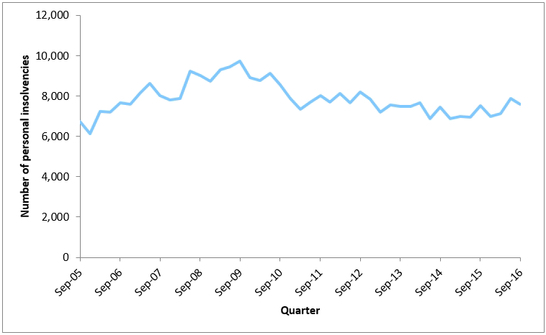
The Australian Financial Security Authority (AFSA) have released their quarterly statistics of personal insolvency and it’s not great news for the ACT. The Territory recorded a slight increase of 4.2% in personal bankruptcies.

The ACT didn’t fair the worst though with the Northern Territory seeing a whopping 29.6% increase, Western Australia 17.4% and Tasmania an unimpressive 19%. All other states saw a decrease in personal insolvencies with New South Wales seeing a 8.4% drop, Queensland 1.8%, South Australia 4.6% but Victoria being the kings by achieving a giant 11.9% decrease in personal bankruptcy.

stats-table-september-copy

There were somewhat comparable increases in other types of personal insolvency agreements such as Part X and Part XI insolvency agreements. All in all the ACT experienced a total rise of 12.5% in all types of personal insolvency, but that was still better than WA with a 29.3% increase and NT with 38.7%.


Generally speaking these stats can be used to indicate the general economic status of each jurisdiction. More accurately speaking it more likely shows the general economic status of each jurisdiction in the previous year or two.

Personal insolvency will usually take roughly one year or more before taking effect. First bills start getting missed, followed by demands, followed by either court action, then bankruptcy notices then finally a debtor is made bankrupt.

The mining boom to gloom would seem to be the most obvious answer for the NT and WA, with both being overly reliant on the hole-digging industry. Tasmania is a bit harder to explain but possibly just part of the general economic woes that afflict the Apple Isle. The Northern Territory stats particularly seem to mesh with data showing an 18% drop in new houses and a 15% drop in business hiring intentions in NT, demonstrating a true slowdown. Queensland, also being heavily reliant on mining managed to buck the trend of increased personal insolvency. This is probably a result of their more diversified economy and certainly shows the issues that can befall states that overly rely on any one industry which is probably a lesson for Australia as a whole.

As far as the ACT is concerned the uptick in personal insolvency would seem to fit well with the aftereffects of the public servant cuts that disproportionately effected the Territory. I suspect the corporate insolvency states will be somewhat similar once they are released.

Owning and operating a soapbox gives me the opportunity to make unsolicited, unqualified predictions. AND I PREDICT that with the Federal Government realising their mistake by mass firing public servants and with numbers now basically back to where they were, that the ACT will see its insolvency numbers improve over the next few quarters and being a relatively tiny jurisdiction will likely even see a complete recovery by the time the next stats are released in January. 

Legal Principle Based on Fictional Characters to be Examined

The best laid schemes o’ Mice an’ Men, Gang aft agley, An’ lea’e us nought but grief an’ pain, For promis’d joy! Still, thou art blest, compar’d wi’ me!

Setting legal precedents on fictional characters could work in theory. I would love to examine a world where decisions about who owned a rug was adjudicated by asking “what would Geoff ‘the dude’ Lebowski do?” or “Would Stringer Bell, as a reasonable person, have made that property transaction?”. It would certainly make things more interesting.

Get to the point

So the United States is a country. And Texas is a state in that country. And sometimes they’re known, though not the most known (am I right Oklahoma?!), to pass crazy legal precedents.

Anyway, in Texas they still have the death penalty. Just like Sudan and Iraq? Yeah, I know it’s weird. So in 2002 the US Supreme Court decided 6-3 that the 8th amendment ban on “cruel and unusual punishments” precluded states from executing people who were considered mentally retarded. (and before anyone says anything, that is a completely acceptable medical term, retarded just means less developed or prevented, blame society if the word has taken on a new meaning).

In Atkins v Virginia the US Supreme Court determined that a person’s disabilities in areas of reasoning, judgment, and control of their impulses means that their level of moral culpability is diminished and therefore must fall short of the normal death penalty pre-requirements to find the most serious adult criminal conduct present. The major problem was that the Supreme Court left open the definition of mentally retarded…you must see where this is going.

So shortly after that decision, the “crazy” states started re-writing their laws to comply with new requirement that you could, in some circumstances, execute a mentally retarded person. Texas took a novel approach (pun definitely intended). A lower court Texas Judge decided to refer to material that the common man could relate to. Much like the ancien common law requirements of the “common passenger on the Clapham omnibus” or “Bondi Bus” in Australia, Texas decided to resort to a book that every year 10 in the western world has read.

73d0b8d9b1f47833fcfb51108665abfb3cccd142cb1c807c106f7802f7cc5baf_1

A lower court Texan Judge took this approach and in 2004 had the reasoning affirmed by the Texan Court of Criminal Appeals. The basics of the decision is that Texas has adopted what is known at the “Lennie test“; if a person is more retarded than Lennie then they are safe to execute but if they have more cognisance than Lennie then they are not safe to execute.

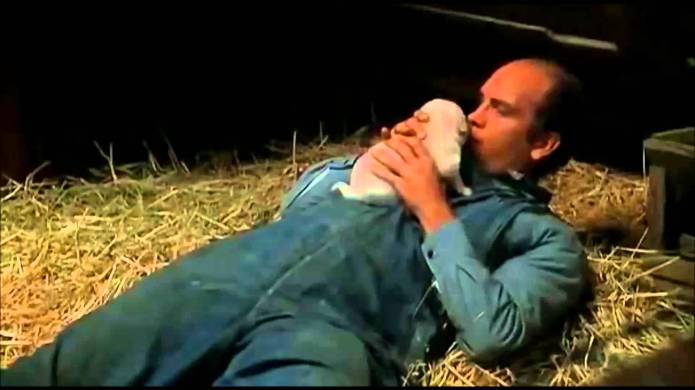
In Steinbeck’s classic “Of Mice and Men”, Lennie was a kind-hearted oaf whose strength was a weakness when juxtaposed against his child-like innocuous understanding of the world. [SPOIL-IES ALERTS-IES]. Lennie’s strength comes back to bite and first he pets a puppy to death and then steps up his game and strangles the rancher’s son’s wife to death when he’s confused by her sexual advances. I must add, beautifully played by the masterful John Malkovich, truly the Bard’s moksha.

Judge Cathy Cochran branched out and said:

“Most Texas citizens might agree that Steinbeck’s Lennie should, by virtue of his lack of reasoning ability and adaptive skills, be exempt” from the death penalty, she wrote. “But, does a consensus of Texas citizens agree that all persons who might legitimately qualify for assistance under the social services definition of mental retardation be exempt from an otherwise constitutional penalty?”

This test went unchallenged until the Texan Courts decided to uphold the execution of Bobby J Moore based largely on the definition of mental retardation. The Texan courts determined that the definition of mental retardation in 2002 under the DSM had since changed which meant that Bobby Moore could be safely executed regardless of the fact that contemporaneous bodies consider that Bobby Moore is sufficiently mentally retarded to be executed.

Mr Moore killed a 70-year old grocery clerk and no one disputes that Mr Moore is mentally challenged. To quote a psychologist in the 2014 hearing Mr Moore most likely “suffers from borderline intellectual functioning.” Including that Mr Moore could not likely tell the time, what day of the week it was, and that his IQ could be as low as 57, being mentally retarded by any measure of the word.

Essentially Texas was relying on the definition of “mentally retarded” as it existed in 1992 instead of adopting a floating definition.

Under current medical standards Mr Moore is considered mentally retarded however not by the the definition of 1992, and is therefore liable for execution as far as Texas is concerned.

The Supreme Court 

As the Senate continues to refuse to hold confirmation hearings for a replacement justice for Antonin Scalia (accurate at time of publication) the Supreme Court has been hesitant to hear any major cases that would have wide implications or that would likely have a unsatisfactory 4-4 split. So this session we are getting the “Lennie” case, determining whether the Federal government can fund spongy playground surfaces and whether it is legal to gerrymander districts on racial lines.

One alternative interpretation that could unite the justices was posited in the Yale Law Journal last year in the article “A reassessment of common law protections for “idiots”” and stated that by applying the standard that existed at the time of the 8th amendment instead of the 1992 definition would protect anyone with the mental faculties below that of a 14 year old. This would likely be sufficient to protect Mr Moore and probably Lennie as well.

The irony is that Lennie himself would not likely be protected under the current Texan test because in the novel he attempted to conceal his crime by hiding the body. Thomas Steinbeck, John’s son, has railed against the Lennie standard:

Prior to reading about Mr. Wilson’s case, I had no idea that the great state of Texas would use a fictional character that my father created to make a point about human loyalty and dedication, i.e., Lennie Small from “Of Mice and Men,” as a benchmark to identify whether defendants with intellectual disability should live or die.

My father was a highly gifted writer who won the Nobel Prize for his ability to create art about the depth of the human experience and condition. His work was certainly not meant to be scientific, and the character of Lennie was never intended to be used to diagnose a medical condition like intellectual disability. I find the whole premise to be insulting, outrageous, ridiculous and profoundly tragic. I am certain that if my father, John Steinbeck, were here, he would be deeply angry and ashamed to see his work used in this way. And the last thing you ever wanted to do, was to make John Steinbeck angry.